
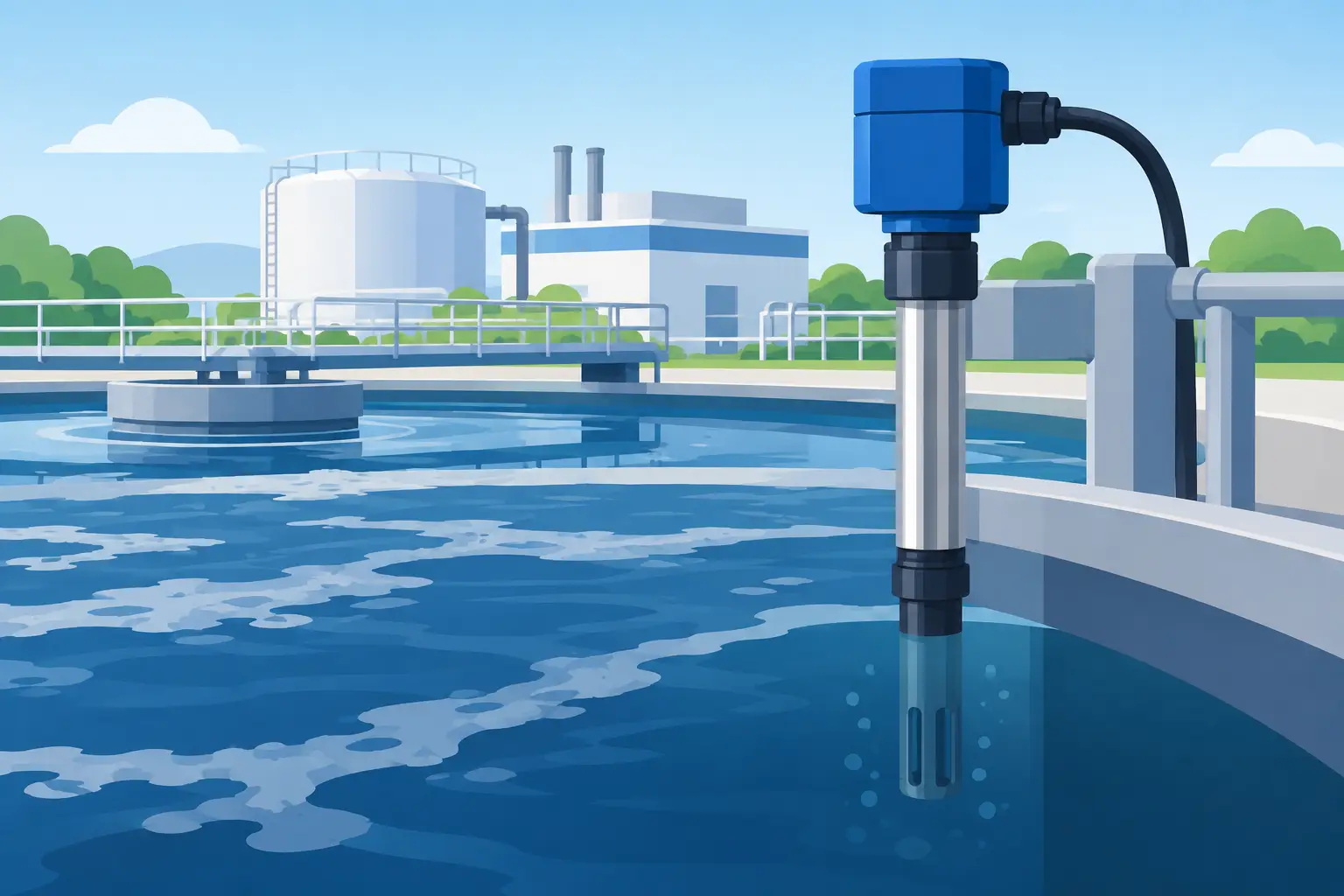


A sulfide reading that arrives after an odor event, a corrosion upset, or a chemical overdose has limited operational value. The best wastewater sulfide sensors provide actionable measurement at the point where operators can still adjust treatment, aeration, conveyance conditions, or chemical feed. For collection systems, headworks, lift stations, digesters, industrial pretreatment systems, and odor-control applications, sensor selection should begin with the decision the measurement must support.
Sulfide is not a single, simple measurement problem. In wastewater, hydrogen sulfide exists in equilibrium with dissolved bisulfide and sulfide ions, and that equilibrium shifts with pH and temperature. A sensor may measure dissolved sulfide in liquid, H2S gas in a sewer headspace, or a related process condition that helps predict sulfide formation. Those are different measurements with different operating limitations.
What Makes the Best Wastewater Sulfide Sensors Useful
The best wastewater sulfide sensors are not necessarily the instruments with the lowest detection limit or the longest feature list. They are the sensors that hold calibration in a dirty process, respond quickly enough for the control loop, and deliver data that operations personnel can trust.
For many wastewater facilities, the first question is whether the goal is safety, odor and corrosion control, treatment optimization, or compliance documentation. A fixed gas detector in a confined-space area serves a different purpose than an online dissolved sulfide analyzer used to pace a nitrate, iron salt, oxidant, or scavenger feed. Trying to use one device for both jobs often creates gaps in coverage.
A practical evaluation should consider the process matrix. Municipal wastewater with variable flows, fats, solids, and intermittent industrial discharges can foul or poison sensing elements differently than a relatively consistent industrial effluent. High humidity, condensation, salt exposure, biological growth, and temperature swings also affect instrument performance. A sensor specification sheet cannot replace an installation review.
Dissolved sulfide analyzers for chemical optimization
Online dissolved sulfide analyzers are the most direct option when a plant needs to manage sulfide in the liquid phase. They can be valuable upstream of odor-control chemical injection, at force main discharge points, in wet wells, or downstream of treatment where verification is required.
Common measurement approaches include ion-selective electrodes, electrochemical methods, colorimetric analyzers, and wet-chemistry systems. Each has trade-offs. Electrode-based instruments can provide relatively continuous data but may need frequent cleaning, calibration, and attention to pH dependence. Colorimetric or wet-chemistry analyzers can offer strong selectivity and traceability, but they introduce reagents, sample conditioning, tubing maintenance, and waste handling.
The critical question is whether the analyzer reports total dissolved sulfide, free sulfide, or a measurement converted to an H2S-equivalent value. Operators should understand the basis of the reported number before using it to set chemical-feed targets. At a higher pH, much of the sulfide may be present as HS-, even when the total sulfur loading remains significant. A process decision based only on H2S concentration can understate the total dissolved sulfide inventory.
Fixed H2S gas sensors for headspace risk
Electrochemical fixed gas detectors are widely used in lift station buildings, enclosed channels, manholes, digester areas, and odor-treatment systems. Their primary value is worker protection, alarm management, ventilation control, and confirmation of headspace conditions associated with odor and corrosion risk.
These sensors are often cost-effective and responsive, but placement matters as much as technology. H2S is heavier than air, yet airflow, turbulence, moisture, and ventilation patterns can create localized concentrations that do not match a single point measurement. A detector mounted where it remains dry and accessible may be too far from the actual gas accumulation zone. Site assessment should consider likely release points, air movement, maintenance access, and the consequences of false alarms or missed alarms.
Fixed gas sensors also need a formal bump-test and calibration program. In a corrosive wastewater environment, a sensor that appears healthy on a control screen may still have reduced sensitivity. Maintenance intervals should be based on actual exposure conditions, not only the manufacturer’s maximum recommended schedule.
Optical and spectroscopic options
Optical and spectroscopic instruments can offer advantages where low maintenance, remote measurement, or high selectivity is needed. Depending on the technology and application, they may be used for gas-phase H2S monitoring, open-path measurement, or specialized liquid analysis.
Their higher capital cost can be justified at critical assets, such as large interceptor systems, high-consequence industrial treatment units, or facilities with recurring community odor complaints. However, optics are not maintenance-free. Condensation, lens contamination, alignment, and sample conditioning can affect readings. The right comparison is lifecycle cost per reliable decision, not purchase price alone.
How to Select a Wastewater Sulfide Sensor
Start by mapping the process response. If the plant will adjust chemical feed based on the measurement, determine the required response time, acceptable control lag, and minimum meaningful change in concentration. If the sensor is for alarms, define alarm thresholds, escalation procedures, and the required fail-safe behavior when communications or power are lost.
Next, verify the expected concentration range. A sensor optimized for low parts-per-billion measurement may be a poor fit for a wet well with frequent high-level sulfide events. Conversely, an instrument designed for high concentrations may lack the resolution needed to optimize a low-dose chemical program. Range selection should account for normal conditions, peak events, and the impact of excursions.
Sample handling deserves close scrutiny for liquid-phase monitoring. Long sample lines can strip H2S, accumulate solids, or create a delay that makes the data unsuitable for control. Pumps, filters, acidification systems, and flow cells add complexity but may be necessary to obtain a representative sample. In some applications, an in-situ probe is preferable. In others, a conditioned sidestream sample is the only defensible approach.
Integration is equally important. The sensor should communicate reliably with the facility’s PLC, SCADA, historian, or remote monitoring platform using the signal and protocol the site can support. A high-quality reading that is trapped in a local display cannot support timely action across a distributed collection system. Consider data logging, alarm notification, remote diagnostics, and the ability to correlate sulfide readings with flow, pH, ORP, temperature, chemical-feed rate, and weather-driven flow events.
Sensor Data Should Improve Treatment, Not Add Noise
Sulfide monitoring delivers the most value when it is paired with a defined operating strategy. A facility may use a dissolved sulfide target to trim chemical feed as loading changes, or use headspace H2S trends to identify a worsening force main condition before it becomes a public odor issue. The objective is not simply to collect more data. It is to reduce uncertainty around chemical use, asset protection, and response timing.
A sensor should not be treated as a substitute for process knowledge. pH, retention time, dissolved oxygen, temperature, sulfate loading, organic strength, and hydraulic conditions all influence sulfide generation and release. A sudden change in H2S may indicate depleted treatment residual, but it may also reflect a flow pattern, industrial discharge, pump cycle, or ventilation change. Trend review is more useful when these operating variables are visible alongside the sulfide signal.
For chemical treatment programs, field verification remains essential. Grab samples and laboratory analysis can confirm instrument performance, particularly during startup, after maintenance, and when process conditions shift. The goal is not to force perfect agreement between every method. It is to establish whether the online measurement is accurate and repeatable enough to support the operating decision.
Q2 Technologies approaches sulfur control as an integrated field problem: measurement, treatment chemistry, application engineering, and execution must work together. The strongest monitoring program identifies where sulfide is forming, determines which measurement is meaningful at that location, and uses the resulting data to improve the treatment response.
A Better Buying Decision Starts With the Failure Mode
Before selecting a sensor, define the failure mode that creates the greatest cost. It may be a confined-space exposure risk, accelerated crown corrosion, a recurring odor complaint, high chemical consumption, or an inability to verify treatment performance. That definition narrows the technology choice and clarifies where the sensor belongs.
The best system is rarely the one with the most instruments. It is the one that produces credible data at the right point in the process and gives operators a practical path to act before sulfide becomes a safety, corrosion, odor, or cost problem.