

Two Related but Distinct Sulfur Problems
H2S and mercaptans get grouped together constantly in crude oil treatment conversations, and for good reason, both are reduced sulfur compounds that create safety, odor, and specification problems. But they are chemically distinct molecules with different structures, different volatility, and different treatment requirements, and understanding that difference at the molecular level clarifies why a single treatment approach rarely handles both equally well.
The Structure of Hydrogen Sulfide
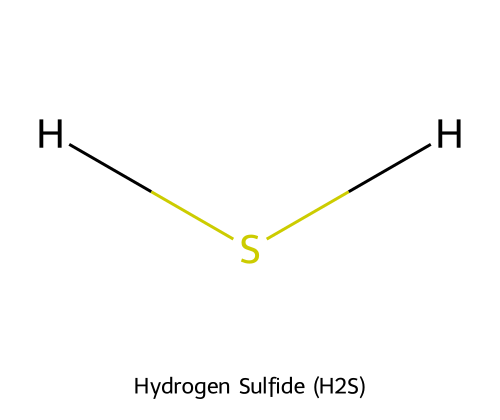
H2S is the simplest sulfur compound found in crude oil: one sulfur atom bonded to two hydrogen atoms in a bent molecular shape, shown below. That bent structure and small size make H2S highly volatile and quick to partition out of a liquid hydrocarbon into any available vapor space, which is why H2S is typically measured and managed as a vapor-phase hazard even though it originates dissolved in the liquid.
Mercaptans: A Family, Not a Single Compound
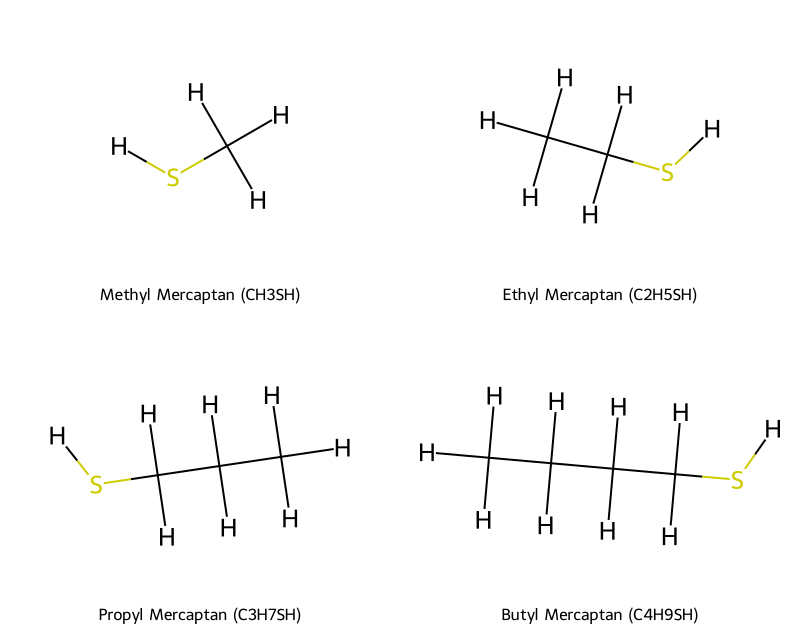
Mercaptans, also called thiols, share a common structural feature, a sulfur-hydrogen (SH) group attached to a carbon chain, but they come in a range of sizes depending on how long that carbon chain is. Methyl mercaptan (CH3SH) and ethyl mercaptan (C2H5SH) are the lightest and most volatile members of the family, while propyl mercaptan (C3H7SH) and butyl mercaptan (C4H9SH) are progressively heavier and less prone to flashing into vapor.
Why Chain Length Changes Treatment Behavior
The same SH group that makes mercaptans reactive is present in every member of the family, but a longer carbon chain adds mass and reduces vapor pressure, which is why light mercaptans behave more like H2S in terms of volatility while heavier mercaptans stay in the liquid phase far more readily. This means a crude stream’s mercaptan speciation, not just its total mercaptan sulfur number, determines how much of the problem a liquid-phase scavenger can actually reach before the lighter species flash off.
Why This Matters for Choosing a Scavenger
A scavenger chemistry optimized for H2S is reacting with a small, highly reactive, highly volatile molecule, while a scavenger optimized for mercaptans has to contend with a range of molecule sizes that behave differently in the same stream. This is part of why some treatment programs use a dedicated H2S scavenger alongside a separate mercaptan-specific chemistry, rather than expecting one product to handle both problems equally well across every mercaptan species present.
Reading a Lab Report With the Molecular Picture in Mind
A crude oil analysis reporting H2S in ppm v/v and total mercaptan sulfur in ppm w is describing two different molecules with two different behaviors, and knowing the basic structure of each compound helps make sense of why the treatment program addressing one number does not automatically move the other.Keeping the molecular picture in mind, a small, volatile H2S molecule versus a family of mercaptans ranging from light and volatile to heavier and less mobile, turns a set of lab numbers into an actual diagnosis of what is happening in the stream.
Mercaptan compounds can create persistent odor and corrosion issues in crude oil streams, and Q2 Technologies has spent more than 25 years refining chemistries that target these compounds directly. Its proprietary mercaptan treatment products work alongside H2S scavengers to deliver crude that meets strict quality and safety specifications. This dual-treatment expertise reflects Q2’s deep understanding of sour crude chemistry. Read more about mercaptan treatment strategies on the Q2 Technologies blog.