
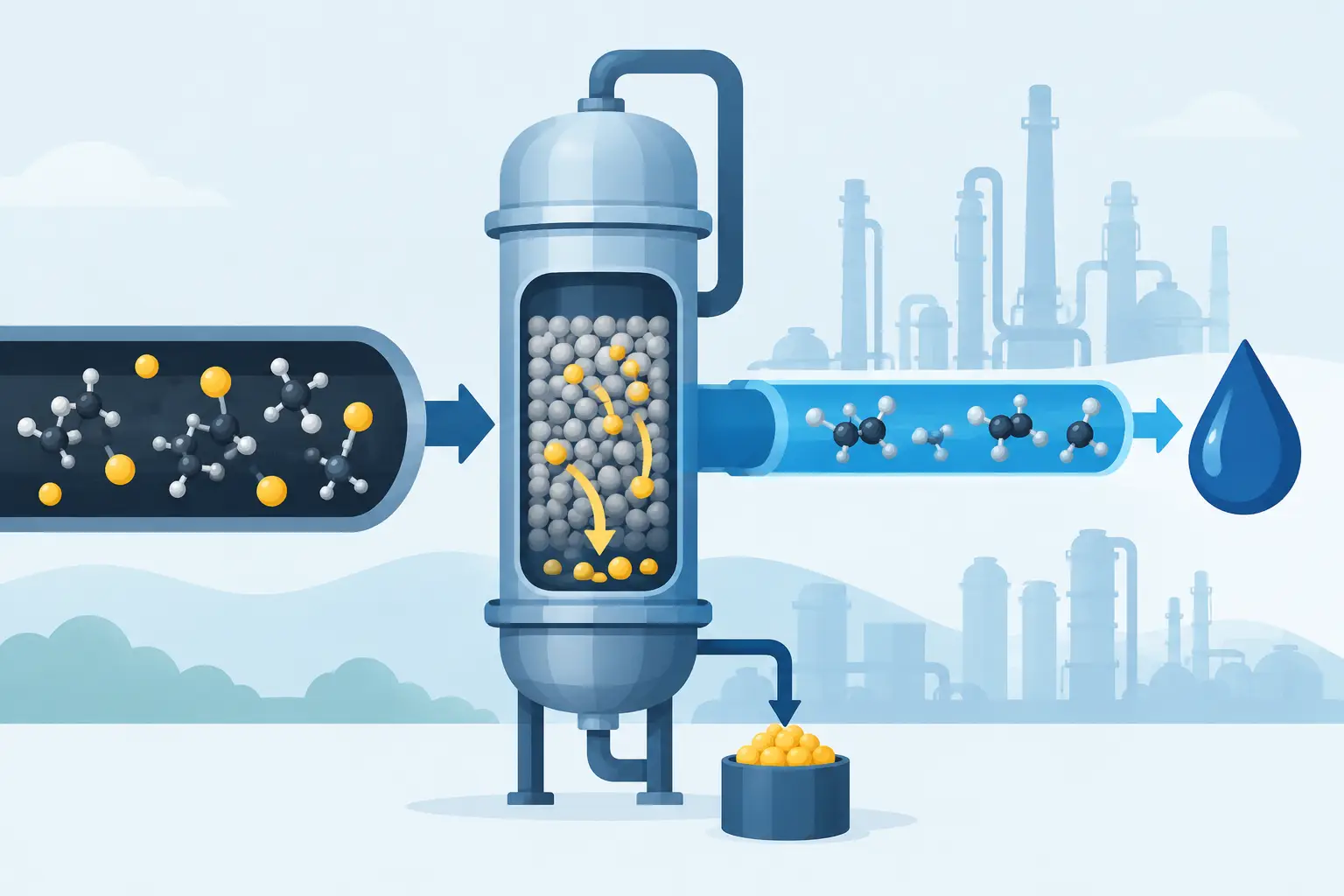
A hydrocarbon stream can meet volume targets and still create an operating problem if sulfur is left untreated. Hydrogen sulfide can expose personnel, accelerate corrosion, and push gas or liquid off specification. Mercaptans can drive odor complaints, reduce product value, and complicate downstream processing. To remove sulfur compounds from hydrocarbons effectively, operators need more than a chemical dose rate. They need a treatment plan matched to the sulfur species, stream conditions, equipment, and required outlet specification.

Why sulfur removal is an operating decision

Sulfur contaminants do not behave the same way across every hydrocarbon application. H2S is highly hazardous and corrosive, particularly where water is present. Mercaptans are often less acutely hazardous but can be difficult to control because of their persistent odor, solubility, and impact on finished-product specifications. Carbonyl sulfide, carbon disulfide, and other sulfur species may also require consideration depending on the feedstock and downstream process.


The first question is not simply how much total sulfur is present. It is which compounds are present, where they are partitioning, and what treatment result the operation needs. A producer treating sour associated gas at a wellsite has different constraints than a terminal handling odor-causing mercaptans in condensate or a biogas facility protecting downstream equipment.


This distinction matters because a treatment method that performs well in one service can be inefficient in another. Over-treating raises chemical spend and disposal volume. Under-treating risks worker exposure, corrosion, off-spec sales, customer rejection, and unplanned downtime.

Characterize the stream before selecting chemistry

Effective sulfur control begins with representative analysis. Total sulfur alone is rarely enough to design a reliable program. Operators should understand H2S and mercaptan concentrations, hydrocarbon phase behavior, water cut, temperature, pressure, flow variability, pH where water is involved, and the presence of oxygen, amines, solids, or other reactive contaminants.


Sampling deserves particular attention. H2S can partition between vapor, liquid hydrocarbon, and aqueous phases. A grab sample from one point may not represent the concentration entering a separator, pipeline, tank, or treating vessel. Mercaptans can also concentrate differently between phases, making it easy to misjudge the actual treatment load.


The required outlet target should be equally clear. Is the goal personnel protection at a tank vent, pipeline-quality gas, lower sulfur in crude, odor control during loading, or protection of a downstream catalyst? Each target affects the right treatment technology, contact time, monitoring plan, and cost basis.

Consider the treatment location

Where treatment occurs can be as important as the chemistry selected. Injection upstream of a separator may allow reaction in a mixed fluid system. Treating a liquid downstream of separation may provide more predictable contact with the hydrocarbon phase. For gas streams, a fixed-bed system or continuous liquid scavenger approach may be appropriate depending on pressure, flow rate, H2S loading, and operating duration.


There is no universal injection point. The best location is where the sulfur species is accessible to the treatment chemistry and where the system provides adequate mixing and residence time without disrupting separation, creating emulsions, or increasing fouling risk.

Methods to remove sulfur compounds from hydrocarbons

Several methods can remove sulfur compounds from hydrocarbons. The right choice depends on contaminant type, concentration, flow profile, available equipment, product specification, and whether the operation is temporary, continuous, or long-term.

Reactive scavenger treatment

Liquid scavengers are commonly used where operators need flexible, field-deployable control of H2S in gas, crude oil, condensate, and mixed hydrocarbon streams. The chemistry reacts with H2S to form a nonvolatile reaction product, reducing the free H2S available for vapor release, corrosion, and exposure.


Scavenger performance depends on reaction kinetics, mixing, temperature, phase contact, and dosage control. A product with high theoretical capacity can still underperform if it is injected into a location with poor distribution or insufficient residence time. In liquid hydrocarbon service, water content and emulsion behavior may materially affect results. In gas service, contact efficiency and liquid carryover must be managed carefully.


Scavengers are often a strong fit for variable flow, remote locations, short-term treatment needs, or systems where installing a large fixed treating unit is not practical. They are not automatically the lowest-cost answer for every high-volume, steady-state application. At sustained high sulfur loads, regenerative or bulk treating technologies may offer a different economic profile.

Regenerative and fixed-bed systems

Amine treating, caustic-based processes, adsorption media, and other engineered systems can provide predictable sulfur removal for stable, larger-scale operations. These systems may be appropriate when a facility has consistent feed conditions, sufficient infrastructure, and a long operating horizon.


Their trade-off is complexity. They require capital, process control, maintenance, and management of spent media or regeneration streams. Feed changes can also affect performance. For example, a system designed around H2S removal may not resolve a mercaptan issue without a separate treatment step.

Mercaptan-specific treatment

Mercaptans should not be treated as a simple extension of H2S control. Their chemistry and behavior can require a different treatment approach, especially where odor thresholds are low or finished-product specifications are strict.


Depending on the stream, treatment may involve extraction, oxidation, sweetening, adsorption, or a specialty chemical program designed for mercaptan reduction. The selection should account for mercaptan chain length, concentration, liquid composition, water content, oxygen availability, and the acceptable impact on product quality. A program that lowers odor at the tank may not meet a downstream sulfur specification, so the performance objective must be defined in advance.

Optimize treatment instead of relying on a fixed dose

A fixed chemical rate can provide a starting point, but it is not an optimization strategy. Sulfur loading changes with production rates, well conditions, temperature, separator performance, crude blending, and upstream operating events. Maintaining the same injection rate through those changes often produces either untreated breakthrough or unnecessary chemical consumption.


An optimized program connects field measurements to treatment adjustments. That may include routine H2S testing at inlet and outlet points, mercaptan analysis where relevant, flow-based dose control, tank-vapor monitoring, and periodic review of reaction-product handling. The objective is to maintain a margin of control without routinely overdosing.

Injection hardware also determines whether chemical capacity becomes real-world performance. A properly selected injection quill, pump, calibration routine, and mixing point can reduce chemical demand more effectively than simply switching products. Poor atomization in gas service, inconsistent pump output, or injection downstream of the available contact time can make a sound chemistry look ineffective.


Q2 Technologies approaches this as a combined chemistry and application-engineering problem: select the treatment chemistry, verify placement and contact, monitor results, and adjust the program as field conditions change.

Manage the side effects of sulfur treatment

Sulfur removal should improve the operation without shifting problems elsewhere. Every treatment plan should consider compatibility with separation equipment, produced-water handling, solids management, vapor control, and downstream processing.


Some scavenger reaction products can contribute to solids, deposits, or disposal loads if the system is not designed around them. Certain treatment approaches may affect emulsion stability or interfere with water clarification. Oxygen-dependent mercaptan treatment can require careful control in hydrocarbon environments. Chemical selection should therefore include a practical review of safety data, handling requirements, spent-product disposition, and compatibility with existing additives.


Field trials are useful when conditions are uncertain. A controlled trial should establish baseline sulfur levels, document dosage and flow, track outlet performance over enough operating variation, and inspect for unintended impacts. A single favorable sample immediately after treatment begins is not enough to establish program reliability.

Build reliability into the sulfur-control program

The strongest sulfur-treatment programs are designed around failure prevention. That means maintaining adequate chemical inventory, confirming pump performance, keeping critical equipment calibrated, establishing response actions for breakthrough, and ensuring operators know what changes in odor, pressure, corrosion, or test results require attention.

Logistics are part of treatment reliability, especially at remote sites or facilities with continuous sour service. A late chemical delivery can become a safety and production event. The same is true when a system lacks visibility into inventory, actual injection rates, or changing inlet concentrations.


The practical goal is not merely to reduce a lab result. It is to keep people safe, protect equipment, preserve product value, and sustain compliant operation at the lowest responsible treatment cost. When sulfur chemistry, field data, injection design, and supply support work together, operators can respond to changing hydrocarbon conditions before a manageable contaminant becomes an operational interruption.

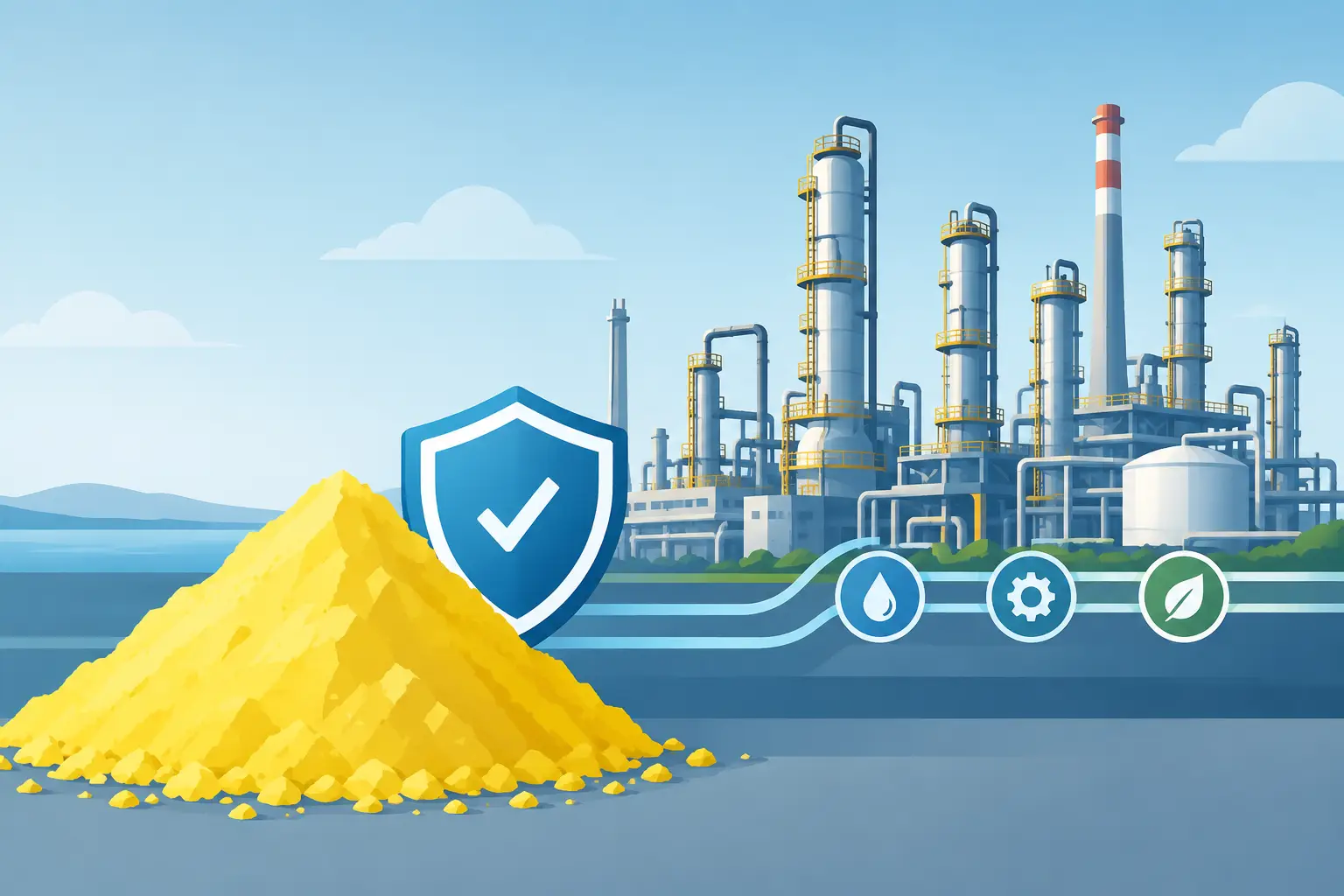
A hydrocarbon stream can meet volume targets and still create an operating problem if sulfur is left untreated. Hydrogen sulfide can expose personnel, accelerate corrosion, and push gas or liquid off specification. Mercaptans can drive odor complaints, reduce product value, and complicate downstream processing. To remove sulfur compounds from hydrocarbons effectively, operators need more than a chemical dose rate. They need a treatment plan matched to the sulfur species, stream conditions, equipment, and required outlet specification.

Why sulfur removal is an operating decision

Sulfur contaminants do not behave the same way across every hydrocarbon application. H2S is highly hazardous and corrosive, particularly where water is present. Mercaptans are often less acutely hazardous but can be difficult to control because of their persistent odor, solubility, and impact on finished-product specifications. Carbonyl sulfide, carbon disulfide, and other sulfur species may also require consideration depending on the feedstock and downstream process.


The first question is not simply how much total sulfur is present. It is which compounds are present, where they are partitioning, and what treatment result the operation needs. A producer treating sour associated gas at a wellsite has different constraints than a terminal handling odor-causing mercaptans in condensate or a biogas facility protecting downstream equipment.


This distinction matters because a treatment method that performs well in one service can be inefficient in another. Over-treating raises chemical spend and disposal volume. Under-treating risks worker exposure, corrosion, off-spec sales, customer rejection, and unplanned downtime.

Characterize the stream before selecting chemistry

Effective sulfur control begins with representative analysis. Total sulfur alone is rarely enough to design a reliable program. Operators should understand H2S and mercaptan concentrations, hydrocarbon phase behavior, water cut, temperature, pressure, flow variability, pH where water is involved, and the presence of oxygen, amines, solids, or other reactive contaminants.


Sampling deserves particular attention. H2S can partition between vapor, liquid hydrocarbon, and aqueous phases. A grab sample from one point may not represent the concentration entering a separator, pipeline, tank, or treating vessel. Mercaptans can also concentrate differently between phases, making it easy to misjudge the actual treatment load.


The required outlet target should be equally clear. Is the goal personnel protection at a tank vent, pipeline-quality gas, lower sulfur in crude, odor control during loading, or protection of a downstream catalyst? Each target affects the right treatment technology, contact time, monitoring plan, and cost basis.

Consider the treatment location

Where treatment occurs can be as important as the chemistry selected. Injection upstream of a separator may allow reaction in a mixed fluid system. Treating a liquid downstream of separation may provide more predictable contact with the hydrocarbon phase. For gas streams, a fixed-bed system or continuous liquid scavenger approach may be appropriate depending on pressure, flow rate, H2S loading, and operating duration.


There is no universal injection point. The best location is where the sulfur species is accessible to the treatment chemistry and where the system provides adequate mixing and residence time without disrupting separation, creating emulsions, or increasing fouling risk.

Methods to remove sulfur compounds from hydrocarbons

Several methods can remove sulfur compounds from hydrocarbons. The right choice depends on contaminant type, concentration, flow profile, available equipment, product specification, and whether the operation is temporary, continuous, or long-term.

Reactive scavenger treatment

Liquid scavengers are commonly used where operators need flexible, field-deployable control of H2S in gas, crude oil, condensate, and mixed hydrocarbon streams. The chemistry reacts with H2S to form a nonvolatile reaction product, reducing the free H2S available for vapor release, corrosion, and exposure.


Scavenger performance depends on reaction kinetics, mixing, temperature, phase contact, and dosage control. A product with high theoretical capacity can still underperform if it is injected into a location with poor distribution or insufficient residence time. In liquid hydrocarbon service, water content and emulsion behavior may materially affect results. In gas service, contact efficiency and liquid carryover must be managed carefully.


Scavengers are often a strong fit for variable flow, remote locations, short-term treatment needs, or systems where installing a large fixed treating unit is not practical. They are not automatically the lowest-cost answer for every high-volume, steady-state application. At sustained high sulfur loads, regenerative or bulk treating technologies may offer a different economic profile.

Regenerative and fixed-bed systems

Amine treating, caustic-based processes, adsorption media, and other engineered systems can provide predictable sulfur removal for stable, larger-scale operations. These systems may be appropriate when a facility has consistent feed conditions, sufficient infrastructure, and a long operating horizon.


Their trade-off is complexity. They require capital, process control, maintenance, and management of spent media or regeneration streams. Feed changes can also affect performance. For example, a system designed around H2S removal may not resolve a mercaptan issue without a separate treatment step.

Mercaptan-specific treatment

Mercaptans should not be treated as a simple extension of H2S control. Their chemistry and behavior can require a different treatment approach, especially where odor thresholds are low or finished-product specifications are strict.


Depending on the stream, treatment may involve extraction, oxidation, sweetening, adsorption, or a specialty chemical program designed for mercaptan reduction. The selection should account for mercaptan chain length, concentration, liquid composition, water content, oxygen availability, and the acceptable impact on product quality. A program that lowers odor at the tank may not meet a downstream sulfur specification, so the performance objective must be defined in advance.

Optimize treatment instead of relying on a fixed dose

A fixed chemical rate can provide a starting point, but it is not an optimization strategy. Sulfur loading changes with production rates, well conditions, temperature, separator performance, crude blending, and upstream operating events. Maintaining the same injection rate through those changes often produces either untreated breakthrough or unnecessary chemical consumption.


An optimized program connects field measurements to treatment adjustments. That may include routine H2S testing at inlet and outlet points, mercaptan analysis where relevant, flow-based dose control, tank-vapor monitoring, and periodic review of reaction-product handling. The objective is to maintain a margin of control without routinely overdosing.

Injection hardware also determines whether chemical capacity becomes real-world performance. A properly selected injection quill, pump, calibration routine, and mixing point can reduce chemical demand more effectively than simply switching products. Poor atomization in gas service, inconsistent pump output, or injection downstream of the available contact time can make a sound chemistry look ineffective.


Q2 Technologies approaches this as a combined chemistry and application-engineering problem: select the treatment chemistry, verify placement and contact, monitor results, and adjust the program as field conditions change.

Manage the side effects of sulfur treatment

Sulfur removal should improve the operation without shifting problems elsewhere. Every treatment plan should consider compatibility with separation equipment, produced-water handling, solids management, vapor control, and downstream processing.


Some scavenger reaction products can contribute to solids, deposits, or disposal loads if the system is not designed around them. Certain treatment approaches may affect emulsion stability or interfere with water clarification. Oxygen-dependent mercaptan treatment can require careful control in hydrocarbon environments. Chemical selection should therefore include a practical review of safety data, handling requirements, spent-product disposition, and compatibility with existing additives.


Field trials are useful when conditions are uncertain. A controlled trial should establish baseline sulfur levels, document dosage and flow, track outlet performance over enough operating variation, and inspect for unintended impacts. A single favorable sample immediately after treatment begins is not enough to establish program reliability.

Build reliability into the sulfur-control program

The strongest sulfur-treatment programs are designed around failure prevention. That means maintaining adequate chemical inventory, confirming pump performance, keeping critical equipment calibrated, establishing response actions for breakthrough, and ensuring operators know what changes in odor, pressure, corrosion, or test results require attention.

Logistics are part of treatment reliability, especially at remote sites or facilities with continuous sour service. A late chemical delivery can become a safety and production event. The same is true when a system lacks visibility into inventory, actual injection rates, or changing inlet concentrations.


The practical goal is not merely to reduce a lab result. It is to keep people safe, protect equipment, preserve product value, and sustain compliant operation at the lowest responsible treatment cost. When sulfur chemistry, field data, injection design, and supply support work together, operators can respond to changing hydrocarbon conditions before a manageable contaminant becomes an operational interruption.
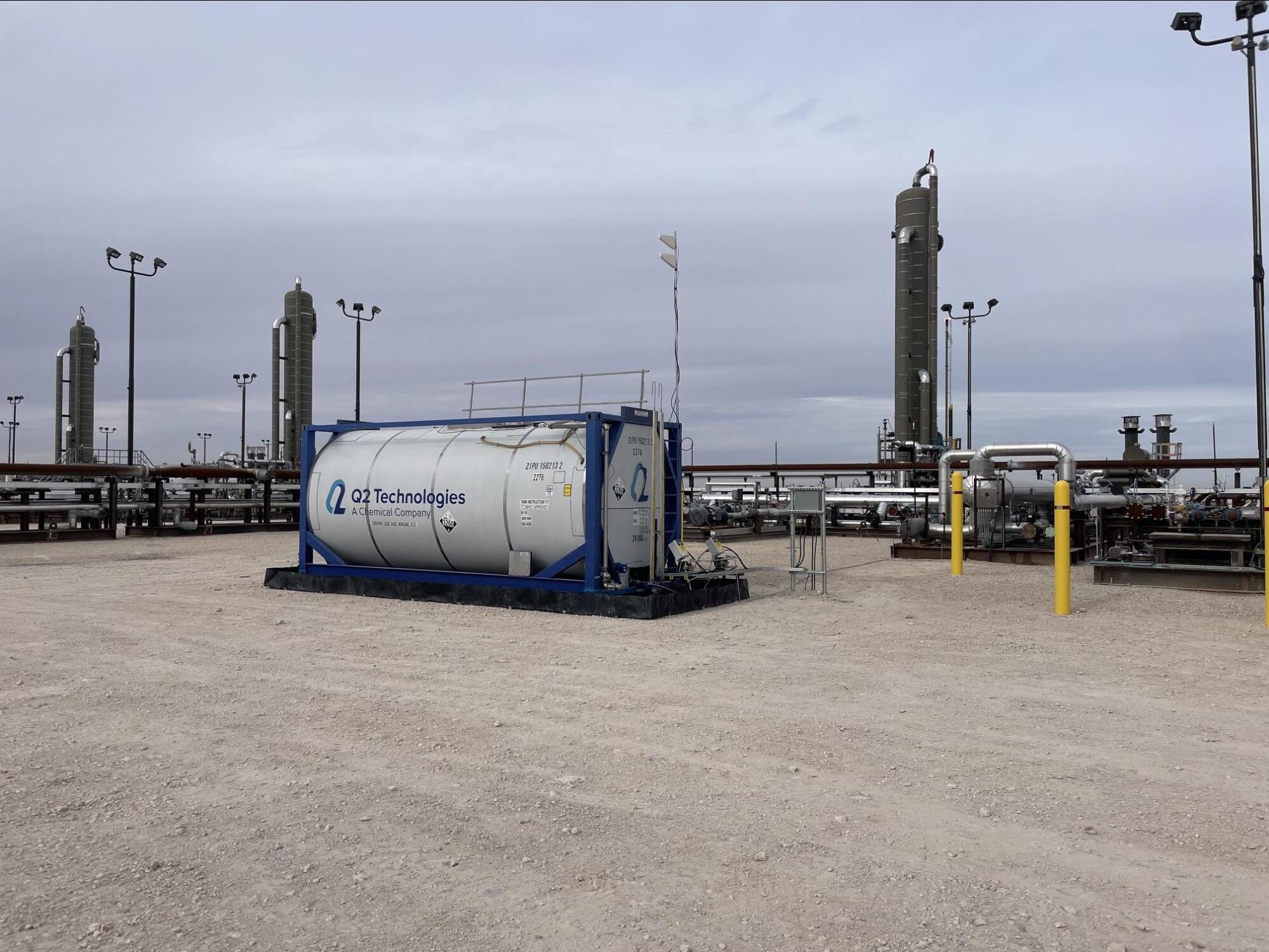
When introduced into a stream afflicted with H2S, the hemiformal decomposes to release formaldehyde, which then reacts with hydrogen sulfide to form stable, non-volatile byproducts such as thiomethylene glycol.  The reaction is typically fast and efficient, particularly in aqueous or mixed-phase environments. Unlike some traditional scavengers, hemiformal can maintain activity across a broad pH range and is less likely to generate problematic solids. When considering if hemiformal is the right product, certain operating conditions are reviewed, such as pH and temperature.

Heading 1

When introduced into a stream afflicted with H2S, the hemiformal decomposes to release formaldehyde, which then reacts with hydrogen sulfide to form stable, non-volatile byproducts such as thiomethylene glycol.  The reaction is typically fast and efficient, particularly in aqueous or mixed-phase environments. Unlike some traditional scavengers, hemiformal can maintain activity across a broad pH range and is less likely to generate problematic solids. When considering if hemiformal is the right product, certain operating conditions are reviewed, such as pH and temperature.

Heading 2

When introduced into a stream afflicted with H2S, the hemiformal decomposes to release formaldehyde, which then reacts with hydrogen sulfide to form stable, non-volatile byproducts such as thiomethylene glycol.  The reaction is typically fast and efficient, particularly in aqueous or mixed-phase environments. Unlike some traditional scavengers, hemiformal can maintain activity across a broad pH range and is less likely to generate problematic solids. When considering if hemiformal is the right product, certain operating conditions are reviewed, such as pH and temperature.

Heading 3

Heading 4

When introduced into a stream afflicted with H2S, the hemiformal decomposes to release formaldehyde, which then reacts with hydrogen sulfide to form stable, non-volatile byproducts such as thiomethylene glycol.  The reaction is typically fast and efficient, particularly in aqueous or mixed-phase environments. Unlike some traditional scavengers, hemiformal can maintain activity across a broad pH range and is less likely to generate problematic solids. When considering if hemiformal is the right product, certain operating conditions are reviewed, such as pH and temperature. 

Key Benefits:

  • Controlled formaldehyde release 
  • Lower vapor pressure and improved safety profile 
  • Broad applicability across liquid and gas-phase systems 
  • Reduced scaling in sour water stripping and other high-temp operations 
  • Hemiformal can make the scavenger safe for transport as it is a very stable compound 

Heading 5

Hemiformal is used in a variety of upstream and midstream applications, including: 

  • Gas sweetening systems 
  • Produced water treatment 
  • Crude oil storage and transport 
  • Sour water stripper overheads 
  • Temporary H2S mitigation during maintenance or turnaround

Its adaptability makes it especially useful in operations where system conditions fluctuate or where traditional triazine-based products may underperform. 

Heading 6

While hemiformal offers many advantages, it is not a one-size-fits-all solution. The rate of formaldehyde release can vary depending on formulation and environmental conditions. Additionally, while safer than raw formaldehyde, hemiformal must still be handled with care and appropriate PPE. 

For optimal results, formulation expertise and application-specific customization are key—something we at Q2 Technologies excel at delivering. 

Related Blogs

Related Articles