

A lift station can operate hydraulically as designed and still become a major operational problem. The familiar rotten-egg odor outside a wet well is rarely just a nuisance. It often signals hydrogen sulfide generation, deteriorating concrete and metal assets, potential worker exposure, resident complaints, and a treatment program that is not matched to actual field conditions. Effective odor control for lift stations starts by treating the source and managing the conditions that allow sulfur compounds to form.
For wastewater operators, the goal is not simply to make odor less noticeable at the fence line. The goal is to reduce sulfide loading before it becomes H2S in the wet well and force main, limit gas release where people and equipment are exposed, and maintain results as flow, temperature, and retention time change.
Why Lift Station Odors Are Difficult to Control
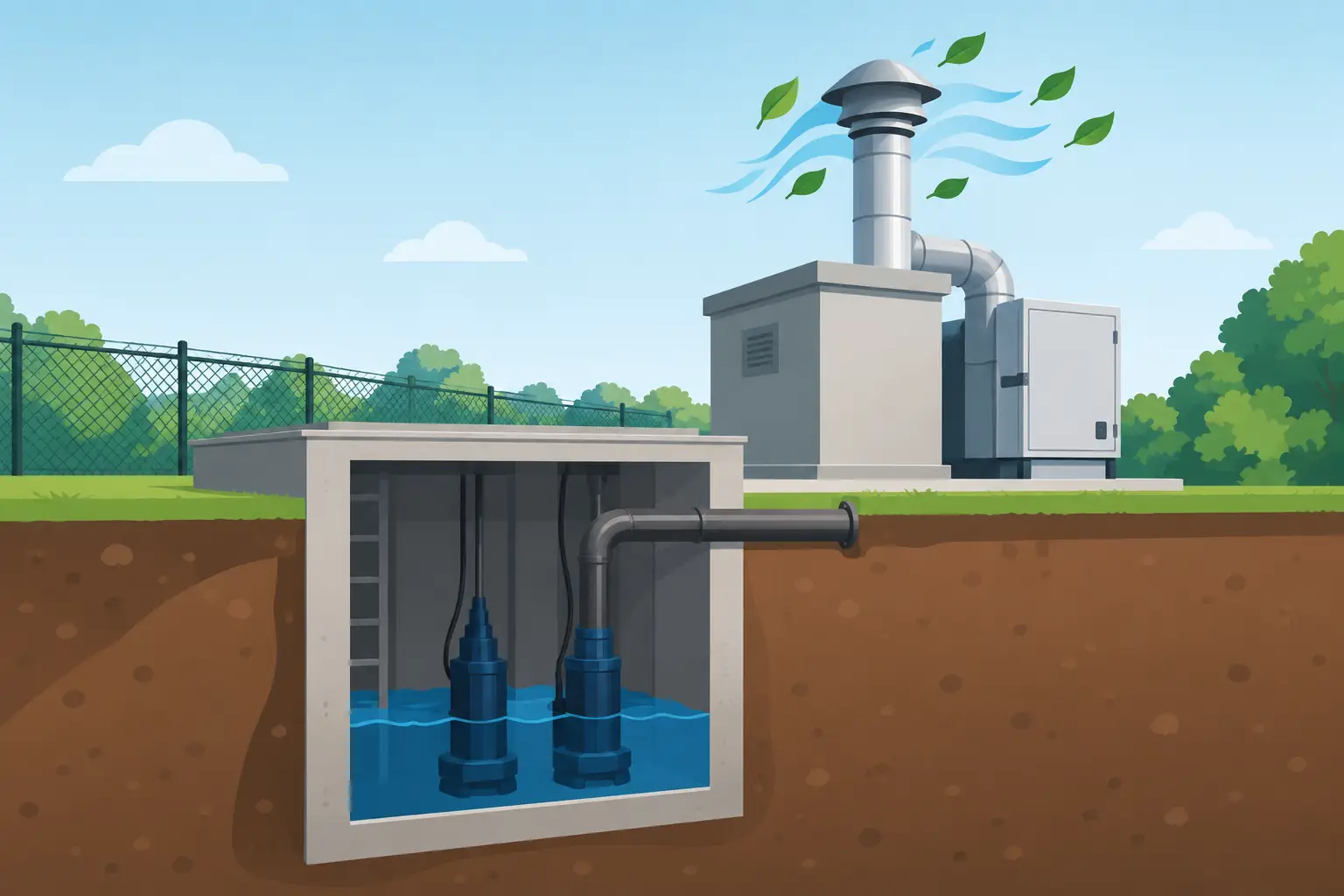
Lift stations create many of the conditions sulfate-reducing bacteria need to produce dissolved sulfides. Wastewater can remain stagnant or move slowly through a gravity collection system, wet well, or force main. As dissolved oxygen is depleted, anaerobic biological activity increases. Sulfate present in the wastewater can be converted to sulfide, which remains dissolved until changes in pH, turbulence, temperature, or pressure release it as hydrogen sulfide gas.
The pump cycle is a common release point. Incoming flow, agitation from pumps, wet-well drawdown, and discharge at the receiving structure can all strip H2S from the liquid. A station may smell acceptable during a daytime inspection yet generate strong odors overnight, during low-flow periods, or after a rainfall event changes wastewater characteristics.
This is why odor performance cannot be judged by a single grab sample or one complaint. Operators need to understand where sulfide is being generated, where it is released, and how the system behaves over a full operating cycle.
Odor Control for Lift Stations Begins With the Sulfide Profile
A practical program begins with field characterization. This should include liquid-phase sulfide measurements where appropriate, H2S readings in the wet-well headspace and downstream structures, pH, temperature, flow patterns, pump run times, and estimated retention time. Records of odor complaints, corrosion damage, and station maintenance can help identify chronic release points.
The chemistry matters because total dissolved sulfide and gas-phase H2S are related but not interchangeable. At lower pH, a greater portion of sulfide exists as molecular H2S, which readily partitions into the gas phase. Higher temperatures and turbulence can further increase release. A treatment program that performs well at one station may underperform at another because the wastewater composition, detention time, and physical configuration differ.
The objective is to establish a baseline that answers operational questions: Is sulfide entering the station from upstream? Is it forming primarily in the force main? Does odor spike after long pump-off intervals? Is the wet well the main source, or is the discharge manhole creating the public-facing problem? Those answers determine where treatment should be applied and what chemistry or equipment strategy is most likely to hold up.
Match the Control Method to the Actual Failure Point
No single approach is right for every lift station. Source control in the liquid phase is generally preferred when the system has enough contact time and the treatment point can be managed consistently. Oxidizing or sulfide-scavenging chemistries can reduce dissolved sulfide before it reaches a release point. Depending on the application, pH adjustment, nitrate-based biological control, iron salts, or other targeted treatments may also be evaluated.
Each option has trade-offs. Iron-based programs can be effective for sulfide precipitation but may increase solids handling requirements and create deposition concerns in some systems. Oxidants can provide rapid results but require careful dose control, safe handling, and attention to demand from organics and other wastewater constituents. Nitrate programs may reduce sulfide formation biologically, but performance depends on retention time, temperature, and microbial conditions. Caustic can suppress H2S release by raising pH, but it does not necessarily eliminate sulfide mass and may introduce scaling, safety, or downstream process considerations.
For stations where odor is concentrated in a confined headspace, vapor-phase treatment may be appropriate. Carbon canisters, dry media, wet scrubbing, biofiltration, and chemical vapor treatment systems can reduce emissions from wet-well vents or enclosed structures. These systems are valuable when treatment of the wastewater itself is impractical, but they must be sized for real H2S loading, humidity, airflow, and peak events. A poorly sized vapor system can appear effective initially and then break through unexpectedly during hot weather or high-flow conditions.
In many cases, the strongest result comes from combining liquid-phase sulfide reduction with targeted headspace treatment at the remaining release point. That combination reduces chemical or media demand while providing added protection during operational swings.
Injection Location Is a Performance Decision
Chemical selection alone does not solve a lift station odor problem. Injection location and contact time often determine whether a program is efficient or wasteful. Injecting directly into a wet well may be practical, but short-cycling pumps or rapid turnover can limit contact time. Injecting upstream of the station or into a force main can provide more time for a reaction to occur, although the line must be assessed for mixing, residence time, access, and compatibility.
The ideal injection point is where treatment can reach the sulfide mass before it is released, with enough mixing to avoid local overfeed and enough residence time to complete the intended reaction. Field testing is necessary because hydraulic assumptions do not always match actual station behavior.
Control Dose by Demand, Not by Habit
Fixed chemical feed rates are easy to operate, but they are rarely optimal over the long term. Wastewater flow and sulfide demand can change with season, rainfall, industrial discharges, infiltration and inflow, pump maintenance, and neighborhood growth. A dose that controls odor in February may be insufficient in August, while a summer dose may overspend chemical during lower-demand periods.
Monitoring converts odor control from a complaint-driven activity into an operating program. At a minimum, operators should trend chemical usage, flow, pump cycles, H2S readings, sulfide measurements, and odor observations. Where conditions justify it, automated monitoring and feed control can adjust treatment based on measured conditions or operating signals such as flow and run time.
A useful performance review looks beyond whether odor was detected. It considers cost per unit of sulfide treated, chemical consumption per million gallons, H2S peaks during pump cycles, media life for vapor systems, corrosion indicators, and the frequency of operator intervention. A program that meets an odor target but requires constant emergency deliveries or manual adjustments may not be operationally reliable.
Q2 Technologies approaches these applications as an integrated treatment problem, pairing application-specific sulfur-control chemistry with field support, monitoring, and delivery planning. That matters at remote or high-consequence stations where a missed delivery or treatment interruption can quickly become a safety, corrosion, and community-relations issue.
Design for Upsets, Not Just Normal Conditions
Normal operating data are useful, but odor complaints often occur during abnormal conditions. Extended power outages, pump failures, bypass events, heavy rain, warmer wastewater, and unusually low nighttime flows can all increase sulfide generation or H2S release. A treatment plan should identify these scenarios before they occur.
For chemical programs, that means confirming available storage capacity, secondary containment, feed-pump redundancy, calibration procedures, and an emergency response dose. For vapor treatment, it means knowing the expected breakthrough behavior and maintaining a replacement plan for media or carbon. Enclosures and ventilation should also be evaluated carefully. Containing odorous air can improve capture, but inadequate ventilation can create elevated H2S concentrations and worker-entry hazards.
Worker safety must remain separate from odor perception. H2S may be noticeable at low concentrations, but odor is not a reliable warning system at higher levels because olfactory fatigue can occur. Confined-space procedures, atmospheric testing, ventilation, and access controls are essential regardless of the odor-control technology in use.
Common Reasons Lift Station Programs Fall Short
Most recurring odor issues trace back to a few practical failures. The first is treating only after complaints begin, when sulfide has already accumulated throughout the system. The second is selecting a chemistry without confirming wastewater demand, contact time, and injection conditions. The third is assuming a single field reading represents a station that changes hour by hour.
Programs also fail when responsibilities are unclear. Operations may see odor at the station, maintenance may see corrosion in the force main, and procurement may focus on delivered chemical cost without visibility into total treatment cost. Bringing those perspectives together produces a more useful decision: the lowest-cost product is not necessarily the lowest-cost odor-control program if it requires overfeeding, frequent service calls, or fails during peak demand.
Build a Program That Can Be Measured
A defensible lift station odor program has a defined baseline, a treatment objective, operating limits, and measurable performance criteria. It should specify where readings are taken, how often results are reviewed, what triggers a dose change, and who responds if H2S rises or odor complaints return.
The right answer may be a carefully controlled liquid treatment, a headspace system, operational changes that reduce detention time, or a combination of methods. What matters is that the approach reflects the station’s actual sulfide profile rather than relying on a one-size-fits-all product choice.
When odor control is treated as a measured process rather than a reaction to the next complaint, lift station operators gain more than a cleaner perimeter. They gain better visibility into corrosive sulfide conditions, more predictable chemical use, and a stronger basis for protecting assets and the communities around their collection system.