

A tank can meet liquid-quality specifications and still create a serious sulfur problem above the fluid line. In the vapor space, hydrogen sulfide (H2S), mercaptans, and related volatile sulfur compounds can concentrate, migrate through vents, expose personnel, corrode equipment, and generate persistent odor complaints. Effective tank vapor sulfur control addresses that headspace as a dynamic operating environment, not as an afterthought to liquid treatment.

The right program depends on the tank’s contents, temperature, turnover, venting design, vapor volume, sulfur loading, and the consequence of a release. A treatment approach that performs well on a low-turnover produced-water tank may be insufficient for a crude storage system with regular truck loading, vapor displacement, and changing H2S concentrations.

Why Tank Vapor Sulfur Control Requires Its Own Strategy

Sulfur compounds reach tank vapor through more than one pathway. Dissolved H2S can evolve from crude oil, condensate, produced water, wastewater, or process liquids as pressure drops. Agitation during filling, recirculation, or unloading increases mass transfer from liquid to vapor. Temperature swings can also change how much sulfur partitions into the headspace, particularly when a tank breathes through daily heating and cooling cycles.

Mercaptans add another layer of complexity. They may create strong odor at relatively low concentrations, and their behavior is not identical to H2S. A program designed only around H2S reduction can leave an odor or product-quality issue unresolved if mercaptans remain present in the vapor stream.


For operators, the risk is rarely limited to a single reading at a vent. Vapor-phase sulfur can affect worker entry procedures, personal monitoring requirements, corrosion rates on tank roofs and appurtenances, nearby equipment, vapor-recovery systems, and community relations. It can also create a recurring operational burden when the only response is emergency chemical treatment after an odor event or elevated gas-monitor reading.

Start With the Actual Vapor Problem

A defensible treatment plan begins with representative data. That means understanding both concentration and behavior over time. A single headspace sample may identify a problem, but it does not necessarily show what happens during loading, at peak afternoon temperatures, after a change in upstream production, or when tank level falls.


Operators should evaluate the vapor composition alongside liquid sulfur content, pH where applicable, tank level, turnover frequency, pressure or vent activity, temperature, and any existing vapor-control equipment. The objective is to identify whether the dominant issue is continuous H2S evolution, intermittent loading-related releases, mercaptan odor, poor mixing of liquid-phase treatment, or a combination of these conditions.


Treatment decisions also depend on where sulfur must be controlled. In some applications, reducing dissolved sulfide before it flashes is the most efficient path. In others, direct treatment of vent gas or a controlled headspace is necessary because vapor emissions remain high despite liquid treatment. A practical program may combine both approaches rather than forcing one chemistry or one injection point to solve every part of the problem.

Liquid Treatment Can Reduce the Vapor Burden

When H2S is dissolved in the tank contents, treatment upstream or within the liquid phase can lower the amount available to partition into vapor. The benefit is straightforward: less available sulfide generally means lower headspace loading. But performance depends on good chemical contact, adequate reaction time, compatible dosage, and a treatment point that accounts for the fluid’s actual flow and mixing behavior.


Injection immediately upstream of a tank may work where there is sufficient turbulence and residence time. In a low-flow or stratified system, however, the chemistry may not distribute evenly before vapors evolve. In those cases, injection location, circulation, and chemical selection matter as much as nominal treatment rate.


Operators should also consider the downstream impact of reaction products. Spent scavenger, solids formation, emulsion tendency, water chemistry, disposal requirements, and compatibility with separation equipment can materially affect program cost. The lowest unit-price product is not always the lowest-cost treatment if it increases maintenance, disposal volume, or off-spec risk.

Vapor-Phase Treatment Handles What Reaches the Headspace

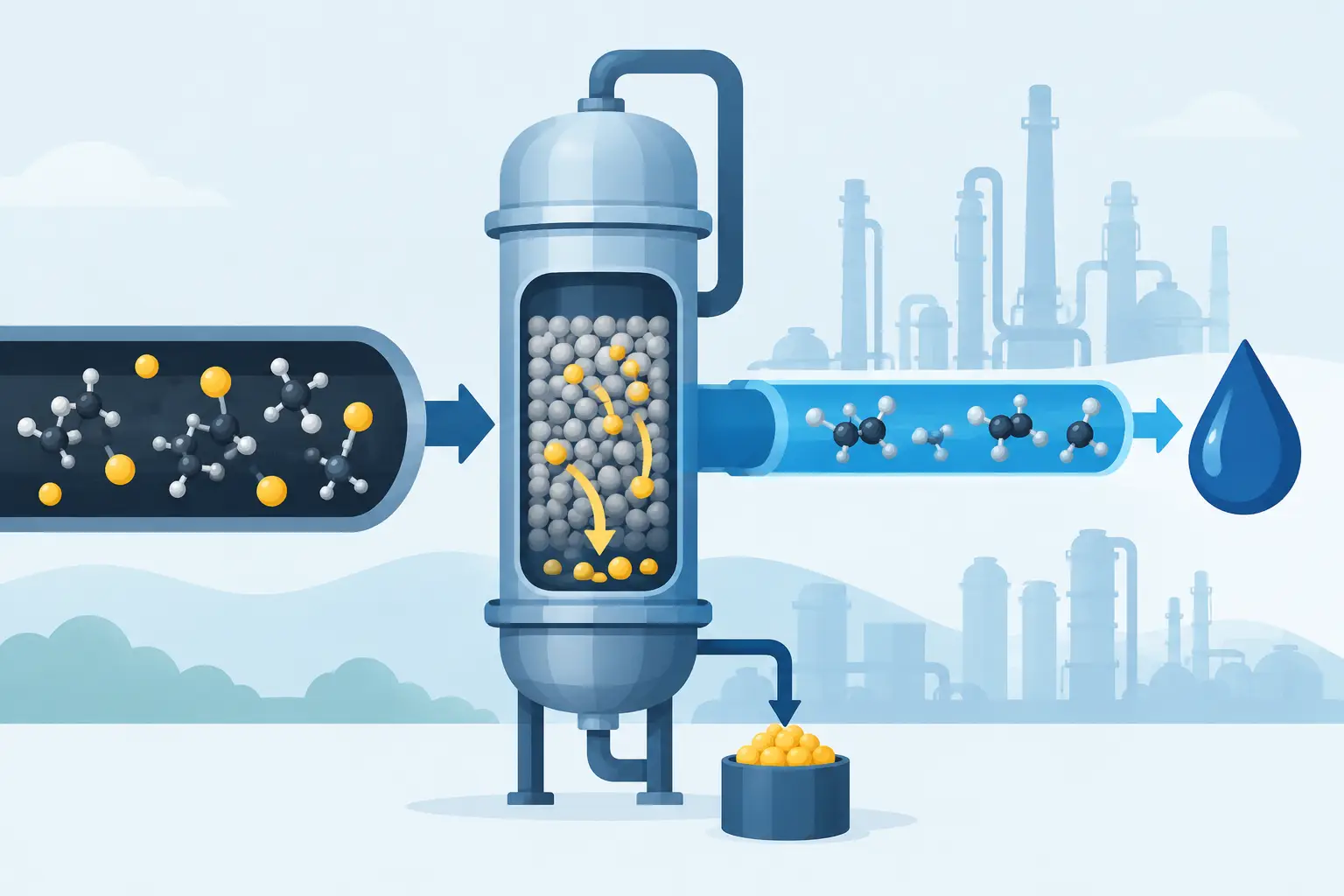
Direct vapor treatment is appropriate when gas-phase sulfur is the primary concern or when tank operations create short-duration emission peaks. Depending on the application, this may involve a treated vent system, packed media, controlled chemical contact, or other vapor-management equipment designed for the gas rate and sulfur loading.


The critical design question is not simply whether a treatment medium has capacity. It is whether the system has enough contact time, mass-transfer efficiency, and operating margin during peak conditions. A vent treatment unit sized only for average emissions can break through during truck loading, pressure equalization, or process upsets.


Moisture, hydrocarbon carryover, oxygen exposure, temperature, and fouling potential should be evaluated before selecting a vapor-treatment technology. These variables influence capacity and maintenance intervals. They can also determine whether a solution is better suited to a continuously vented tank, an intermittent loading rack, or a remote site with limited maintenance access.

Treatment Chemistry Must Match the Operating Window

H2S scavenger selection should be based on sulfur species, phase, concentration range, flow profile, reaction kinetics, and equipment constraints. There is no universal scavenger that provides the same result across crude, produced water, landfill gas condensate, wastewater, and refined-product service.


For liquid applications, fast reaction kinetics can be valuable where residence time is limited. Yet a fast reaction alone does not guarantee field performance. The chemistry must remain effective within the system’s pH and temperature range, disperse into the target phase, and avoid creating unacceptable operational side effects.


For mercaptan treatment, product selection must reflect the specific mercaptan species and the treatment objective. Odor suppression, sulfur reduction, and final product specification are related but distinct goals. Confirming the required outcome before treatment begins prevents a program from measuring the wrong success metric.


Q2 Technologies approaches these applications as field treatment systems, pairing specialized sulfur-control chemistry with application engineering, monitoring, and delivery support. That integrated approach matters because a chemical program can only perform consistently when the product, dosage, injection method, and supply reliability are aligned.

Monitoring Turns Sulfur Control Into an Operating Program

Tank vapor sulfur control is often undermined by treating dosage as fixed while operating conditions change. Production rates shift. Tank turnover changes. Liquid sulfur loading varies by well, batch, season, or upstream processing condition. Without measurement, chemical use can drift toward under-treatment, unnecessary over-treatment, or both at different times.


Routine vapor and liquid testing establishes whether treatment is controlling the source, the headspace, or neither. Continuous monitoring may be warranted where exposure risk is high, where emissions are regulated, or where operating conditions change quickly. At lower-risk sites, structured field sampling can still provide enough information to adjust dosage and verify results.


A useful monitoring plan connects measurements to decisions. If headspace H2S rises after loading, the response may involve injection timing, not necessarily more chemical. If vent treatment breaks through before its expected service interval, the root cause could be increased sulfur load, liquid carryover, channeling, or a change in vent flow. Data should lead to targeted corrections rather than a blanket increase in treatment spend.

Common Failure Points in Tank Vapor Control

Many vapor-control problems can be traced to an incomplete view of the system. Four issues appear frequently: treating only the liquid when vapor loading remains high, treating only the vent while the liquid source continues to worsen, using average conditions to size for peak events, and overlooking mercaptans because H2S is the primary safety concern.

Injection hardware is another common weak point. A quality scavenger cannot compensate for an injection quill that is plugged, poorly positioned, or feeding into a stagnant zone. Likewise, tank internals, level changes, and stratification can change chemical distribution over time. Field inspection and verification are part of treatment optimization, not separate maintenance tasks.


Logistics deserve the same attention. Tanks with continuous sulfur exposure need dependable replenishment, clear inventory visibility, and a response plan for changing treatment demand. A treatment interruption can quickly become a safety, odor, or compliance issue, especially at remote sites where replacement product and service support are not immediately available.

Build Margin for Real Operating Conditions

The strongest programs are designed around variability, not ideal conditions. They account for sulfur spikes, turnover changes, weather effects, equipment maintenance, and sampling uncertainty. That does not mean overdosing chemistry or oversizing every piece of equipment. It means defining a realistic operating envelope and maintaining enough treatment capacity and response capability to stay within it.


For facilities managing recurring vapor sulfur issues, the practical next step is to map where sulfur enters the tank, when it transfers into vapor, and how treatment performance changes during normal operations. That operating picture creates a far better basis for chemical selection, monitoring, and cost control than reacting to the next high H2S reading at the vent.

A tank can meet liquid-quality specifications and still create a serious sulfur problem above the fluid line. In the vapor space, hydrogen sulfide (H2S), mercaptans, and related volatile sulfur compounds can concentrate, migrate through vents, expose personnel, corrode equipment, and generate persistent odor complaints. Effective tank vapor sulfur control addresses that headspace as a dynamic operating environment, not as an afterthought to liquid treatment.

The right program depends on the tank’s contents, temperature, turnover, venting design, vapor volume, sulfur loading, and the consequence of a release. A treatment approach that performs well on a low-turnover produced-water tank may be insufficient for a crude storage system with regular truck loading, vapor displacement, and changing H2S concentrations.

Why Tank Vapor Sulfur Control Requires Its Own Strategy

Sulfur compounds reach tank vapor through more than one pathway. Dissolved H2S can evolve from crude oil, condensate, produced water, wastewater, or process liquids as pressure drops. Agitation during filling, recirculation, or unloading increases mass transfer from liquid to vapor. Temperature swings can also change how much sulfur partitions into the headspace, particularly when a tank breathes through daily heating and cooling cycles.

Mercaptans add another layer of complexity. They may create strong odor at relatively low concentrations, and their behavior is not identical to H2S. A program designed only around H2S reduction can leave an odor or product-quality issue unresolved if mercaptans remain present in the vapor stream.


For operators, the risk is rarely limited to a single reading at a vent. Vapor-phase sulfur can affect worker entry procedures, personal monitoring requirements, corrosion rates on tank roofs and appurtenances, nearby equipment, vapor-recovery systems, and community relations. It can also create a recurring operational burden when the only response is emergency chemical treatment after an odor event or elevated gas-monitor reading.

Start With the Actual Vapor Problem

A defensible treatment plan begins with representative data. That means understanding both concentration and behavior over time. A single headspace sample may identify a problem, but it does not necessarily show what happens during loading, at peak afternoon temperatures, after a change in upstream production, or when tank level falls.


Operators should evaluate the vapor composition alongside liquid sulfur content, pH where applicable, tank level, turnover frequency, pressure or vent activity, temperature, and any existing vapor-control equipment. The objective is to identify whether the dominant issue is continuous H2S evolution, intermittent loading-related releases, mercaptan odor, poor mixing of liquid-phase treatment, or a combination of these conditions.


Treatment decisions also depend on where sulfur must be controlled. In some applications, reducing dissolved sulfide before it flashes is the most efficient path. In others, direct treatment of vent gas or a controlled headspace is necessary because vapor emissions remain high despite liquid treatment. A practical program may combine both approaches rather than forcing one chemistry or one injection point to solve every part of the problem.

Liquid Treatment Can Reduce the Vapor Burden

When H2S is dissolved in the tank contents, treatment upstream or within the liquid phase can lower the amount available to partition into vapor. The benefit is straightforward: less available sulfide generally means lower headspace loading. But performance depends on good chemical contact, adequate reaction time, compatible dosage, and a treatment point that accounts for the fluid’s actual flow and mixing behavior.


Injection immediately upstream of a tank may work where there is sufficient turbulence and residence time. In a low-flow or stratified system, however, the chemistry may not distribute evenly before vapors evolve. In those cases, injection location, circulation, and chemical selection matter as much as nominal treatment rate.


Operators should also consider the downstream impact of reaction products. Spent scavenger, solids formation, emulsion tendency, water chemistry, disposal requirements, and compatibility with separation equipment can materially affect program cost. The lowest unit-price product is not always the lowest-cost treatment if it increases maintenance, disposal volume, or off-spec risk.

Vapor-Phase Treatment Handles What Reaches the Headspace

Direct vapor treatment is appropriate when gas-phase sulfur is the primary concern or when tank operations create short-duration emission peaks. Depending on the application, this may involve a treated vent system, packed media, controlled chemical contact, or other vapor-management equipment designed for the gas rate and sulfur loading.


The critical design question is not simply whether a treatment medium has capacity. It is whether the system has enough contact time, mass-transfer efficiency, and operating margin during peak conditions. A vent treatment unit sized only for average emissions can break through during truck loading, pressure equalization, or process upsets.


Moisture, hydrocarbon carryover, oxygen exposure, temperature, and fouling potential should be evaluated before selecting a vapor-treatment technology. These variables influence capacity and maintenance intervals. They can also determine whether a solution is better suited to a continuously vented tank, an intermittent loading rack, or a remote site with limited maintenance access.

Treatment Chemistry Must Match the Operating Window

H2S scavenger selection should be based on sulfur species, phase, concentration range, flow profile, reaction kinetics, and equipment constraints. There is no universal scavenger that provides the same result across crude, produced water, landfill gas condensate, wastewater, and refined-product service.


For liquid applications, fast reaction kinetics can be valuable where residence time is limited. Yet a fast reaction alone does not guarantee field performance. The chemistry must remain effective within the system’s pH and temperature range, disperse into the target phase, and avoid creating unacceptable operational side effects.


For mercaptan treatment, product selection must reflect the specific mercaptan species and the treatment objective. Odor suppression, sulfur reduction, and final product specification are related but distinct goals. Confirming the required outcome before treatment begins prevents a program from measuring the wrong success metric.


Q2 Technologies approaches these applications as field treatment systems, pairing specialized sulfur-control chemistry with application engineering, monitoring, and delivery support. That integrated approach matters because a chemical program can only perform consistently when the product, dosage, injection method, and supply reliability are aligned.

Monitoring Turns Sulfur Control Into an Operating Program

Tank vapor sulfur control is often undermined by treating dosage as fixed while operating conditions change. Production rates shift. Tank turnover changes. Liquid sulfur loading varies by well, batch, season, or upstream processing condition. Without measurement, chemical use can drift toward under-treatment, unnecessary over-treatment, or both at different times.


Routine vapor and liquid testing establishes whether treatment is controlling the source, the headspace, or neither. Continuous monitoring may be warranted where exposure risk is high, where emissions are regulated, or where operating conditions change quickly. At lower-risk sites, structured field sampling can still provide enough information to adjust dosage and verify results.


A useful monitoring plan connects measurements to decisions. If headspace H2S rises after loading, the response may involve injection timing, not necessarily more chemical. If vent treatment breaks through before its expected service interval, the root cause could be increased sulfur load, liquid carryover, channeling, or a change in vent flow. Data should lead to targeted corrections rather than a blanket increase in treatment spend.

Common Failure Points in Tank Vapor Control

Many vapor-control problems can be traced to an incomplete view of the system. Four issues appear frequently: treating only the liquid when vapor loading remains high, treating only the vent while the liquid source continues to worsen, using average conditions to size for peak events, and overlooking mercaptans because H2S is the primary safety concern.

Injection hardware is another common weak point. A quality scavenger cannot compensate for an injection quill that is plugged, poorly positioned, or feeding into a stagnant zone. Likewise, tank internals, level changes, and stratification can change chemical distribution over time. Field inspection and verification are part of treatment optimization, not separate maintenance tasks.


Logistics deserve the same attention. Tanks with continuous sulfur exposure need dependable replenishment, clear inventory visibility, and a response plan for changing treatment demand. A treatment interruption can quickly become a safety, odor, or compliance issue, especially at remote sites where replacement product and service support are not immediately available.

Build Margin for Real Operating Conditions

The strongest programs are designed around variability, not ideal conditions. They account for sulfur spikes, turnover changes, weather effects, equipment maintenance, and sampling uncertainty. That does not mean overdosing chemistry or oversizing every piece of equipment. It means defining a realistic operating envelope and maintaining enough treatment capacity and response capability to stay within it.


For facilities managing recurring vapor sulfur issues, the practical next step is to map where sulfur enters the tank, when it transfers into vapor, and how treatment performance changes during normal operations. That operating picture creates a far better basis for chemical selection, monitoring, and cost control than reacting to the next high H2S reading at the vent.

When introduced into a stream afflicted with H2S, the hemiformal decomposes to release formaldehyde, which then reacts with hydrogen sulfide to form stable, non-volatile byproducts such as thiomethylene glycol.  The reaction is typically fast and efficient, particularly in aqueous or mixed-phase environments. Unlike some traditional scavengers, hemiformal can maintain activity across a broad pH range and is less likely to generate problematic solids. When considering if hemiformal is the right product, certain operating conditions are reviewed, such as pH and temperature.

Heading 1

When introduced into a stream afflicted with H2S, the hemiformal decomposes to release formaldehyde, which then reacts with hydrogen sulfide to form stable, non-volatile byproducts such as thiomethylene glycol.  The reaction is typically fast and efficient, particularly in aqueous or mixed-phase environments. Unlike some traditional scavengers, hemiformal can maintain activity across a broad pH range and is less likely to generate problematic solids. When considering if hemiformal is the right product, certain operating conditions are reviewed, such as pH and temperature.

Heading 2

When introduced into a stream afflicted with H2S, the hemiformal decomposes to release formaldehyde, which then reacts with hydrogen sulfide to form stable, non-volatile byproducts such as thiomethylene glycol.  The reaction is typically fast and efficient, particularly in aqueous or mixed-phase environments. Unlike some traditional scavengers, hemiformal can maintain activity across a broad pH range and is less likely to generate problematic solids. When considering if hemiformal is the right product, certain operating conditions are reviewed, such as pH and temperature.

Heading 3

Heading 4

When introduced into a stream afflicted with H2S, the hemiformal decomposes to release formaldehyde, which then reacts with hydrogen sulfide to form stable, non-volatile byproducts such as thiomethylene glycol.  The reaction is typically fast and efficient, particularly in aqueous or mixed-phase environments. Unlike some traditional scavengers, hemiformal can maintain activity across a broad pH range and is less likely to generate problematic solids. When considering if hemiformal is the right product, certain operating conditions are reviewed, such as pH and temperature. 

Key Benefits:

  • Controlled formaldehyde release 
  • Lower vapor pressure and improved safety profile 
  • Broad applicability across liquid and gas-phase systems 
  • Reduced scaling in sour water stripping and other high-temp operations 
  • Hemiformal can make the scavenger safe for transport as it is a very stable compound 

Heading 5

Hemiformal is used in a variety of upstream and midstream applications, including: 

  • Gas sweetening systems 
  • Produced water treatment 
  • Crude oil storage and transport 
  • Sour water stripper overheads 
  • Temporary H2S mitigation during maintenance or turnaround

Its adaptability makes it especially useful in operations where system conditions fluctuate or where traditional triazine-based products may underperform. 

Heading 6

While hemiformal offers many advantages, it is not a one-size-fits-all solution. The rate of formaldehyde release can vary depending on formulation and environmental conditions. Additionally, while safer than raw formaldehyde, hemiformal must still be handled with care and appropriate PPE. 

For optimal results, formulation expertise and application-specific customization are key—something we at Q2 Technologies excel at delivering. 

Related Blogs

Related Articles