
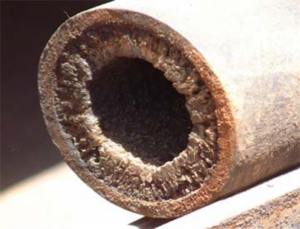
Anyone who runs a triazine-based H2S scavenging program eventually runs into dithiazine. It is the byproduct that forms when triazine does its job, and in its polymerized form it is responsible for some of the most stubborn fouling problems in sour gas treating. This article explains what dithiazine is, how it forms, why producers, midstream companies, and gas processors work so hard to avoid it, and whether it has any redeeming qualities at all.

What Is Dithiazine?

Dithiazine is the primary reaction product created when a triazine H2S scavenger captures hydrogen sulfide. When monoethanolamine (MEA) triazine reacts with H2S, two of the three nitrogen positions in the triazine ring are replaced by sulfur in sequence, releasing the parent amine and leaving behind a six-membered ring containing two sulfur atoms and one nitrogen atom. That ring is dithiazine, more precisely 5-(2-hydroxyethyl)hexahydro-1,3,5-dithiazine when it comes from MEA triazine.

In its initial monomeric form, dithiazine is a manageable, soluble compound that stays in the spent scavenger liquid and is normally hauled off and disposed of in an injection well. The trouble starts when that monomer does not stay put.

How Dithiazine Forms

Dithiazine is not something that occurs naturally in a reservoir. It is created entirely through the chemistry of the scavenging reaction, and understanding the two stages of that chemistry explains why it becomes a problem.

Stage one: the intended reaction

One mole of triazine reacts with two moles of H2S in a fast, irreversible reaction. Each sulfur substitution liberates one molecule of the parent amine, and the end product is monomeric dithiazine. This is exactly what the scavenger is designed to do, and if the reaction stopped here dithiazine would be little more than a disposal line item.

Stage two: the polymerization that causes trouble

The problem is that the reaction often does not stop at the monomer. When H2S is in excess, the bisulfide anion produced from the reaction of H2S with the liberated amine attacks the dithiazine ring and opens it. Once that ring opens, the fragments link together into a long-chain polymer. The result is an insoluble, intractable solid known as amorphous polymeric dithiazine, often abbreviated apDTZ. This species is not simply a different physical form of the monomer. It is a genuinely different, highly cross-linked material that will not redissolve in the scavenger fluid.

The Conditions That Drive Solid Formation

Amorphous dithiazine is most likely when H2S is the excess reactant, when scavenger contact is poorly controlled, and when the product is pushed past its optimum spent point. Direct-injection and static-mixer setups, where contact is hard to control, tend to produce more solids than well-managed contact towers. High inlet H2S concentrations make matters worse because they create exactly the H2S-rich conditions the polymerization needs.

Why Producers, Midstream Companies, and Gas Processors Dislike Dithiazine

Once amorphous dithiazine forms, it is one of the more expensive nuisances in gas treating. The problems fall into several categories.

Equipment fouling and plugging

Amorphous dithiazine is the main cause of fouling in bubble-tower contactors and shows up throughout the system. The solid coats and plugs valves, contactor and treater tower internals, static mixers, separators, pipelines, storage and truck tanks, and water disposal wells. In the worst cases it builds up in piping until it restricts or stops flow entirely.

Downtime and manual cleanout

Because the polymer is so insoluble, cleanup is slow and labor-intensive. Equipment frequently has to be taken offline so that crews can physically chip and scrape the deposits away. Each cleanout means lost production, labor cost, and disposal cost for the removed solids.

Pipeline risk

When deposits form inside a pipeline and cannot be pigged out, the consequences escalate quickly. In severe cases the only remedy is pipeline replacement, which is enormously expensive and one of the outcomes operators most want to avoid.

Downstream and corrosion effects

The fallout is not limited to the scavenger system. Amine salts formed from spent triazine can travel downstream and create corrosion problems in refinery equipment, and deposits derived from triazine byproducts have been found fouling crude unit overheads. The amines released during scavenging also raise system pH, which can reduce the effectiveness of scale inhibitors and drive up the chemical needed to control scale.

Higher chemical and operating cost

Poorly controlled contact that produces solids usually also means chemical overuse, so the same conditions that foul equipment tend to inflate the scavenger bill at the same time. The combined burden of chemical, cleaning, downtime, and disposal is the real reason operators treat dithiazine as a cost to be engineered out.

Is There Anything Good About Dithiazine?

Nope.


Honestly, dithiazine has no recognized secondary or commercial use, and the industry generally regards it purely as waste. The fairest way to find something positive is to separate the harmless monomer from the troublesome polymer.


The genuinely useful thing is that forming dithiazine is the mechanism by which H2S is permanently removed. The reaction is irreversible, so the toxic, corrosive hydrogen sulfide is locked into a far less volatile compound that can be handled and disposed of safely. In its monomeric form, dithiazine is exactly the stable, manageable end product the scavenger is supposed to make. So that’s a win, right?! Its presence in the spent fluid is also a useful signal: measuring how much dithiazine has formed tells an operator how spent the scavenger is and how much capacity remains, which supports better dosing decisions.


There is also a practical upside to how well the problem is now understood. Amorphous dithiazine can be chemically dissolved rather than only chipped away. Oxidizing treatments based on hydrogen peroxide and related peroxide chemistries react with and break down the solid, turning a manual cleanout into a chemical one. So while no one wants the polymer, it is no longer the dead end it once was.


The cleanest summary is this: monomeric dithiazine is the desirable outcome of scavenging, and amorphous polymeric dithiazine is the failure mode to avoid. The whole art of running a triazine program is capturing the H2S while keeping the byproduct in its benign form.

Managing and Minimizing Dithiazine

Operators reduce dithiazine solids by controlling the scavenging reaction rather than letting it run to excess. Well-designed contact towers give better control than direct injection, dosing the product so it does not get pushed far past its optimum spent point keeps the monomer from polymerizing, and monitoring the degree spent through compositional analysis flags trouble before solids deposit. Where high H2S concentrations or chronic fouling make MEA triazine impractical, operators often switch to MMA triazine or non-triazine scavenger chemistries that are far less prone to forming the polymeric solid.

Q2 Technologies provides advanced technology solutions to the energy sector. To learn more about how we support midstream operators, refiners, and producers, visit www.q2technologies.com.

Anyone who runs a triazine-based H2S scavenging program eventually runs into dithiazine. It is the byproduct that forms when triazine does its job, and in its polymerized form it is responsible for some of the most stubborn fouling problems in sour gas treating. This article explains what dithiazine is, how it forms, why producers, midstream companies, and gas processors work so hard to avoid it, and whether it has any redeeming qualities at all.

What Is Dithiazine?

Dithiazine is the primary reaction product created when a triazine H2S scavenger captures hydrogen sulfide. When monoethanolamine (MEA) triazine reacts with H2S, two of the three nitrogen positions in the triazine ring are replaced by sulfur in sequence, releasing the parent amine and leaving behind a six-membered ring containing two sulfur atoms and one nitrogen atom. That ring is dithiazine, more precisely 5-(2-hydroxyethyl)hexahydro-1,3,5-dithiazine when it comes from MEA triazine.

In its initial monomeric form, dithiazine is a manageable, soluble compound that stays in the spent scavenger liquid and is normally hauled off and disposed of in an injection well. The trouble starts when that monomer does not stay put.

How Dithiazine Forms

Dithiazine is not something that occurs naturally in a reservoir. It is created entirely through the chemistry of the scavenging reaction, and understanding the two stages of that chemistry explains why it becomes a problem.

Stage one: the intended reaction

One mole of triazine reacts with two moles of H2S in a fast, irreversible reaction. Each sulfur substitution liberates one molecule of the parent amine, and the end product is monomeric dithiazine. This is exactly what the scavenger is designed to do, and if the reaction stopped here dithiazine would be little more than a disposal line item.

Stage two: the polymerization that causes trouble

The problem is that the reaction often does not stop at the monomer. When H2S is in excess, the bisulfide anion produced from the reaction of H2S with the liberated amine attacks the dithiazine ring and opens it. Once that ring opens, the fragments link together into a long-chain polymer. The result is an insoluble, intractable solid known as amorphous polymeric dithiazine, often abbreviated apDTZ. This species is not simply a different physical form of the monomer. It is a genuinely different, highly cross-linked material that will not redissolve in the scavenger fluid.

The Conditions That Drive Solid Formation

Amorphous dithiazine is most likely when H2S is the excess reactant, when scavenger contact is poorly controlled, and when the product is pushed past its optimum spent point. Direct-injection and static-mixer setups, where contact is hard to control, tend to produce more solids than well-managed contact towers. High inlet H2S concentrations make matters worse because they create exactly the H2S-rich conditions the polymerization needs.

Why Producers, Midstream Companies, and Gas Processors Dislike Dithiazine

Once amorphous dithiazine forms, it is one of the more expensive nuisances in gas treating. The problems fall into several categories.

Equipment fouling and plugging

Amorphous dithiazine is the main cause of fouling in bubble-tower contactors and shows up throughout the system. The solid coats and plugs valves, contactor and treater tower internals, static mixers, separators, pipelines, storage and truck tanks, and water disposal wells. In the worst cases it builds up in piping until it restricts or stops flow entirely.

Downtime and manual cleanout

Because the polymer is so insoluble, cleanup is slow and labor-intensive. Equipment frequently has to be taken offline so that crews can physically chip and scrape the deposits away. Each cleanout means lost production, labor cost, and disposal cost for the removed solids.

Pipeline risk

When deposits form inside a pipeline and cannot be pigged out, the consequences escalate quickly. In severe cases the only remedy is pipeline replacement, which is enormously expensive and one of the outcomes operators most want to avoid.

Downstream and corrosion effects

The fallout is not limited to the scavenger system. Amine salts formed from spent triazine can travel downstream and create corrosion problems in refinery equipment, and deposits derived from triazine byproducts have been found fouling crude unit overheads. The amines released during scavenging also raise system pH, which can reduce the effectiveness of scale inhibitors and drive up the chemical needed to control scale.

Higher chemical and operating cost

Poorly controlled contact that produces solids usually also means chemical overuse, so the same conditions that foul equipment tend to inflate the scavenger bill at the same time. The combined burden of chemical, cleaning, downtime, and disposal is the real reason operators treat dithiazine as a cost to be engineered out.

Is There Anything Good About Dithiazine?

Nope.


Honestly, dithiazine has no recognized secondary or commercial use, and the industry generally regards it purely as waste. The fairest way to find something positive is to separate the harmless monomer from the troublesome polymer.


The genuinely useful thing is that forming dithiazine is the mechanism by which H2S is permanently removed. The reaction is irreversible, so the toxic, corrosive hydrogen sulfide is locked into a far less volatile compound that can be handled and disposed of safely. In its monomeric form, dithiazine is exactly the stable, manageable end product the scavenger is supposed to make. So that’s a win, right?! Its presence in the spent fluid is also a useful signal: measuring how much dithiazine has formed tells an operator how spent the scavenger is and how much capacity remains, which supports better dosing decisions.


There is also a practical upside to how well the problem is now understood. Amorphous dithiazine can be chemically dissolved rather than only chipped away. Oxidizing treatments based on hydrogen peroxide and related peroxide chemistries react with and break down the solid, turning a manual cleanout into a chemical one. So while no one wants the polymer, it is no longer the dead end it once was.


The cleanest summary is this: monomeric dithiazine is the desirable outcome of scavenging, and amorphous polymeric dithiazine is the failure mode to avoid. The whole art of running a triazine program is capturing the H2S while keeping the byproduct in its benign form.

Managing and Minimizing Dithiazine

Operators reduce dithiazine solids by controlling the scavenging reaction rather than letting it run to excess. Well-designed contact towers give better control than direct injection, dosing the product so it does not get pushed far past its optimum spent point keeps the monomer from polymerizing, and monitoring the degree spent through compositional analysis flags trouble before solids deposit. Where high H2S concentrations or chronic fouling make MEA triazine impractical, operators often switch to MMA triazine or non-triazine scavenger chemistries that are far less prone to forming the polymeric solid.

Q2 Technologies provides advanced technology solutions to the energy sector. To learn more about how we support midstream operators, refiners, and producers, visit www.q2technologies.com.

When introduced into a stream afflicted with H2S, the hemiformal decomposes to release formaldehyde, which then reacts with hydrogen sulfide to form stable, non-volatile byproducts such as thiomethylene glycol.  The reaction is typically fast and efficient, particularly in aqueous or mixed-phase environments. Unlike some traditional scavengers, hemiformal can maintain activity across a broad pH range and is less likely to generate problematic solids. When considering if hemiformal is the right product, certain operating conditions are reviewed, such as pH and temperature.

Heading 1

When introduced into a stream afflicted with H2S, the hemiformal decomposes to release formaldehyde, which then reacts with hydrogen sulfide to form stable, non-volatile byproducts such as thiomethylene glycol.  The reaction is typically fast and efficient, particularly in aqueous or mixed-phase environments. Unlike some traditional scavengers, hemiformal can maintain activity across a broad pH range and is less likely to generate problematic solids. When considering if hemiformal is the right product, certain operating conditions are reviewed, such as pH and temperature.

Heading 2

When introduced into a stream afflicted with H2S, the hemiformal decomposes to release formaldehyde, which then reacts with hydrogen sulfide to form stable, non-volatile byproducts such as thiomethylene glycol.  The reaction is typically fast and efficient, particularly in aqueous or mixed-phase environments. Unlike some traditional scavengers, hemiformal can maintain activity across a broad pH range and is less likely to generate problematic solids. When considering if hemiformal is the right product, certain operating conditions are reviewed, such as pH and temperature.

Heading 3

Heading 4

When introduced into a stream afflicted with H2S, the hemiformal decomposes to release formaldehyde, which then reacts with hydrogen sulfide to form stable, non-volatile byproducts such as thiomethylene glycol.  The reaction is typically fast and efficient, particularly in aqueous or mixed-phase environments. Unlike some traditional scavengers, hemiformal can maintain activity across a broad pH range and is less likely to generate problematic solids. When considering if hemiformal is the right product, certain operating conditions are reviewed, such as pH and temperature. 

Key Benefits:

  • Controlled formaldehyde release 
  • Lower vapor pressure and improved safety profile 
  • Broad applicability across liquid and gas-phase systems 
  • Reduced scaling in sour water stripping and other high-temp operations 
  • Hemiformal can make the scavenger safe for transport as it is a very stable compound 

Heading 5

Hemiformal is used in a variety of upstream and midstream applications, including: 

  • Gas sweetening systems 
  • Produced water treatment 
  • Crude oil storage and transport 
  • Sour water stripper overheads 
  • Temporary H2S mitigation during maintenance or turnaround

Its adaptability makes it especially useful in operations where system conditions fluctuate or where traditional triazine-based products may underperform. 

Heading 6

While hemiformal offers many advantages, it is not a one-size-fits-all solution. The rate of formaldehyde release can vary depending on formulation and environmental conditions. Additionally, while safer than raw formaldehyde, hemiformal must still be handled with care and appropriate PPE. 

For optimal results, formulation expertise and application-specific customization are key—something we at Q2 Technologies excel at delivering. 

In this Blog

Related Blogs

Dithiazine in H2S Scavenging: How It Forms and Why It Fouls Equipment

What is dithiazine and why do gas processors fight it? A technical look at how amorphous dithiazine forms, the damage it causes, and how to dissolve it.

FAQs

  1. What is dithiazine made of?

    Dithiazine is a six-membered ring containing two sulfur atoms and one nitrogen atom, formed when a triazine H2S scavenger reacts with hydrogen sulfide. From MEA triazine the specific compound is 5-(2-hydroxyethyl)hexahydro-1,3,5-dithiazine. It is a reaction product, not a naturally occurring substance.


  2. Why does dithiazine turn into a solid?

    When hydrogen sulfide is present in excess, a bisulfide anion opens the dithiazine ring and the fragments polymerize into a long-chain, highly insoluble material called amorphous dithiazine. This polymer will not redissolve in the scavenger fluid, which is why it deposits and fouls equipment.


  3. How do you remove amorphous dithiazine deposits?

    Historically, deposits had to be taken offline and physically chipped or scraped out. Today, oxidizing chemical treatments based on hydrogen peroxide and related peroxide chemistries can react with and dissolve the solid, allowing it to be flushed away with far less manual labor.


  4. Can dithiazine formation be prevented?

    It cannot be eliminated entirely, since forming dithiazine is how triazine removes H2S, but the troublesome polymeric form can be largely avoided. Controlling contact, avoiding overspending the scavenger, monitoring the degree spent, and selecting a lower-fouling chemistry such as MMA triazine or a non-triazine scavenger all reduce solid formation.

Related Articles