
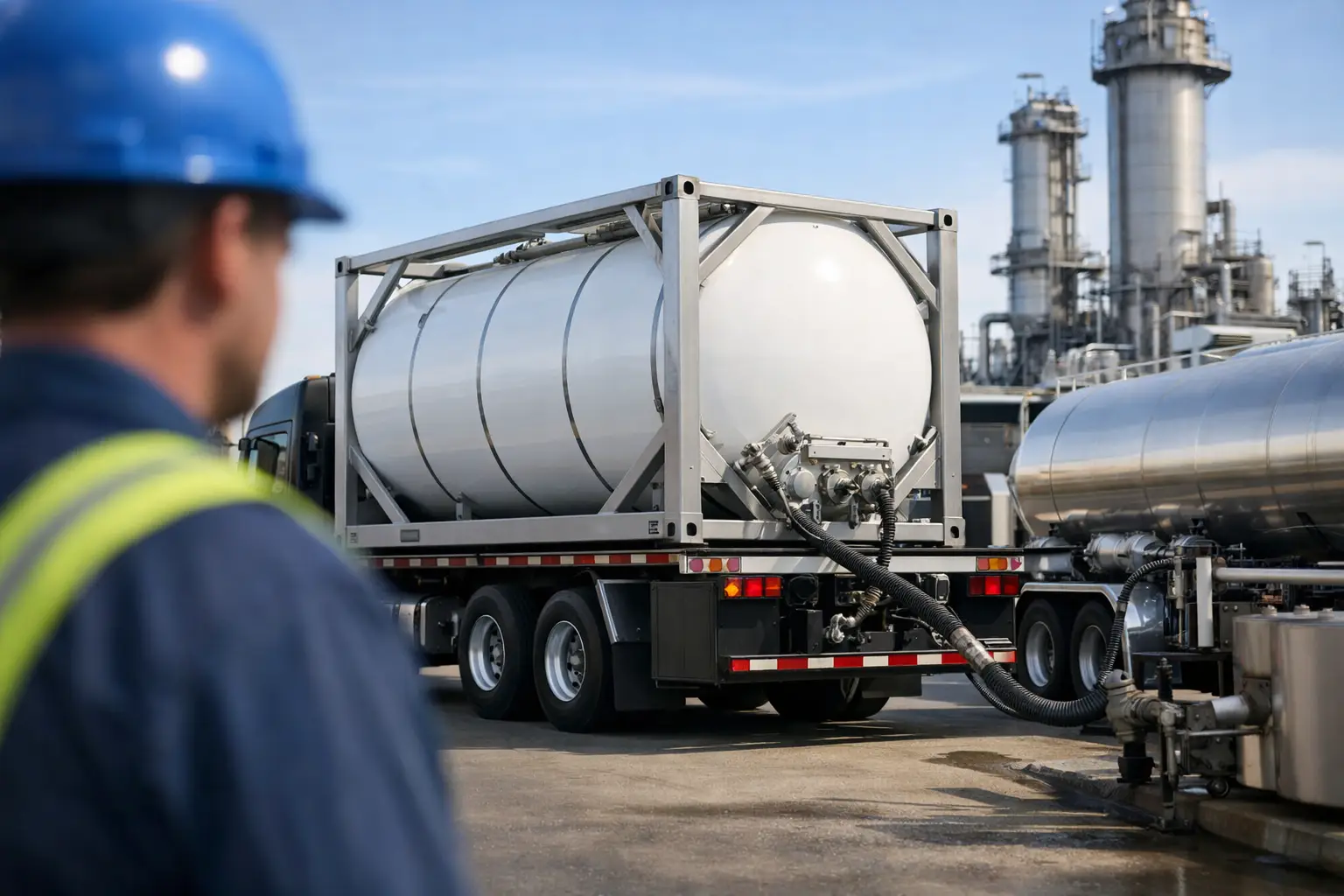


A treatment program can be technically sound on paper and still underperform because the chemical reaches the site in the wrong condition, the wrong quantity, or at the wrong time. That is why iso tank chemical delivery matters in sulfur treatment operations. When scavengers, odor-control products, and other specialty chemistries support continuous processes, delivery is not a back-office detail. It is part of treatment performance.
For operators managing H2S, mercaptans, and related sulfur contaminants, the logistics method affects more than freight efficiency. It influences product quality, site handling, refill frequency, inventory planning, exposure risk, and the ability to keep injection systems running without interruption. In applications where treatment failure can lead to corrosion, off-spec product, odor complaints, or safety exposure, that difference is operationally significant.
Why iso tank chemical delivery fits industrial treatment programs
ISO tanks are designed for bulk liquid transport in a closed, durable container format that moves efficiently across truck, rail, and marine networks. For specialty industrial chemicals, that creates a practical advantage over smaller package formats and, in many cases, over transfer methods that introduce more touchpoints.
The main value is control. A properly managed ISO tank chemical delivery program helps reduce contamination risk, maintain consistent product condition, and support predictable unloading at the site. For customers using sulfur scavengers or odor-control chemistries in active field environments, those details directly affect whether the chemistry performs as intended once it reaches the injection point or storage vessel.
There is also a scale advantage. Many treatment programs do not consume enough volume for dedicated tank trailers to be the best fit on every route, but they need more efficiency than drums or totes can provide. ISO tanks often sit in that middle ground well, especially for distributed operations, changing demand profiles, or projects that require supply flexibility across regions.
Where ISO tank chemical delivery makes the most sense
Not every site needs the same logistics model. The right fit depends on consumption rate, storage capacity, unloading capability, chemical compatibility, and the cost of a stockout.
ISO tank delivery tends to make sense where treatment demand is recurring and operational continuity matters. That includes sour crude stabilization, natural gas treatment, terminal operations, wastewater odor control, landfill gas conditioning, and biogas upgrading. In these environments, chemical supply is tied to process reliability, not just procurement timing.
It can also be a strong option for locations with space constraints or variable run rates. A site that cannot justify frequent handling of packaged product, but also does not want to overcommit to large-volume dedicated assets, may benefit from ISO tank scheduling. The same is true for operators balancing multiple treatment points and trying to standardize inventory practices.
The trade-off is that ISO tanks are not automatically the best answer for every facility. Some sites have unloading setups built around fixed bulk storage with local tanker replenishment. Others have low enough usage that totes remain more practical. The decision should be based on total operating fit, not on the container alone.
Performance is not just about the container
An ISO tank by itself does not solve a chemical delivery problem. The performance comes from how the delivery program is designed and managed.
First, the chemistry must be matched correctly to the application. A scavenger used for H2S treatment in crude oil service has different performance requirements than a mercaptan treatment product in condensate or an odor-control chemistry in wastewater. If the chemical selection is wrong, even a flawless delivery system will only move the problem faster.
Second, inventory planning has to reflect real consumption. Industrial treatment demand is rarely flat. H2S loading can shift with production changes, feed composition, upset conditions, temperature swings, and water content. If the logistics model assumes static usage, sites either run short or carry more chemical than necessary. Both outcomes add cost.
Third, site equipment matters. Unloading connections, transfer pumps, storage compatibility, venting practices, and injection reliability all affect whether delivered product is handled safely and efficiently. A strong delivery program accounts for those details before the tank arrives, not after the driver reaches the gate.
Safety and product integrity in chemical delivery
For industrial buyers, safety claims need to connect to real handling conditions. ISO tank chemical delivery can improve safety because it reduces the number of individual containers handled on site and limits repeated transfer events. Fewer manual touches generally mean fewer opportunities for spills, exposure, or labeling errors.
Product integrity is just as important. Specialty sulfur-treatment chemistries are purchased for performance, not simply for volume. If contamination, improper handling, or avoidable exposure affects the product before use, the result shows up in the field as inefficient treatment, unstable injection response, or increased consumption.
Closed-container transport helps protect against some of those risks, but execution still matters. Cleaning standards, material compatibility, proper documentation, and disciplined loading and unloading procedures remain essential. Industrial customers should expect those controls as part of the service, not as optional extras.
The link between delivery reliability and chemical efficiency
Chemical spend is often evaluated by price per gallon, but field performance tells the real story. If delivery delays force an operator to change dosage strategy, switch products temporarily, or run inventory too lean, treatment efficiency usually suffers before accounting notices the freight issue.
That is one reason reliable logistics can reduce total treatment cost. When product arrives on schedule and in usable condition, operators can maintain a more consistent injection program, monitor response accurately, and make dosage changes based on process data instead of supply disruptions. Over time, that supports better consumption control.
In sulfur-related applications, consistency matters because overtreating and undertreating both carry penalties. Overtreating increases chemical use and can create downstream handling concerns. Undertreating increases corrosion risk, odor issues, compliance exposure, and product-quality problems. A dependable ISO tank delivery model supports steadier operation between those two extremes.
What buyers should evaluate in an ISO tank chemical delivery provider
Industrial operators should look beyond whether a supplier can physically ship an ISO tank. The more useful question is whether the provider understands the process consequences of late, inconsistent, or poorly managed deliveries.
A capable partner should be able to discuss application-specific handling requirements, expected consumption patterns, refill planning, regional logistics constraints, and site readiness. They should also understand that chemical delivery is tied to treatment outcomes. In sulfur-control programs, logistics, monitoring, and field support need to work together.
That is especially relevant when demand changes quickly. A provider serving gas plants, production sites, terminals, landfills, or wastewater facilities should be able to respond to seasonal shifts, process upsets, startup conditions, and expansion activity without turning supply planning into a recurring site problem.
For many customers, the best model is not chemical supply on one side and technical support on the other. It is an integrated approach where chemistry selection, application engineering, monitoring insight, and delivery planning are aligned. That operating model is where a technical solutions provider creates more value than a commodity reseller.
Why the delivery model should match the treatment objective
The right logistics choice depends on what the chemical is expected to do in the process. If the objective is to protect pipeline quality, reduce H2S in liquid hydrocarbons, control mercaptans, or manage odor emissions, the delivery model should support that outcome with as little operational friction as possible.
That means looking at the full chain: how the product is manufactured, loaded, transported, staged, unloaded, stored, and injected. Weakness at any point can reduce treatment performance or increase cost. In that sense, iso tank chemical delivery is not only a freight decision. It is part of the treatment system.
Companies such as Q2 Technologies tend to approach this differently because the chemistry and the field application are central to the logistics plan. When supply decisions are informed by actual treatment conditions, customers get a program built around performance rather than just shipment movement.
The practical takeaway is simple. If your operation depends on continuous sulfur treatment, ask whether your current delivery method is helping the chemistry perform at its best or merely getting product to the fence line. There is a difference, and over time it shows up in uptime, chemical efficiency, and avoidable operating risk.
When chemical treatment is critical to safety, compliance, and asset protection, the strongest delivery strategy is the one that operators do not have to worry about.