

Drone Strike on Saudi Oil Facility Shakes Global Supply

Saudi Arabia’s all important Abqaiq processing facility was attacked with drones over the weekend shutting about 5% of global crude output as shown on Figure 1.

Global Oil Prices Surge After the Attack

Oil prices already surged while Saudi Aramco’s sources declared that it might take months for Saudi oil production to return to normal. This is a game changer for crude prices. West Texas Intermediate crude for October delivery (CLV19) was up 11.5% on Monday. On at $61.18 a barrel, hitting a session high of $63.34 a barrel. Brent crude prices for November delivery (BRNX19.L) the global benchmark, initially shot up 18% as trading began late Sunday. That gain pared to a rise of $7.16, or 12%, to $67.42 a barrel on Monday.
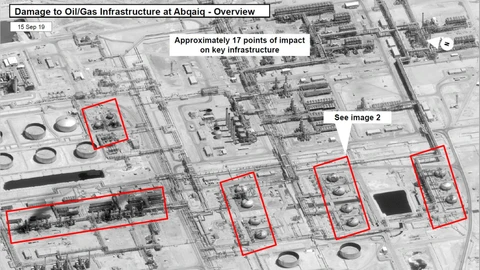
Figure 1. Extent of damage to Saudi Arabia Abqaiq infrastructure. Source: U.S. Government/DigitalGlobe, via Associated Press.

International Community Responds to Outage

The giant Saudi plant that was struck cleans crude oil of impurities, a necessary step before it can be exported and fed into refineries. The attack cut Saudi output by 5.7 million barrels a day, or around half its production. Big countries such as the United States and China have reserves designed to handle even a major outage over the short term. President Trump already announced that he would release US emergency supplies and producers around the world said that there are enough reserves to make up for the shortfall.

Long-Term Risks for Global Oil Markets

However, traders worry about the long-term price increase in oil to reflect how global supply can be hit sharply, overnight, and without warning. The vulnerability of the Middle East facilities and the sudden elimination of spare capacity have been exposed during these unstable times in the region as shown in Figure 2. Similarly, the broader market will assess how fast other suppliers can respond to the oil shortage and it is important to watch how quickly America’s shale can ramp up.
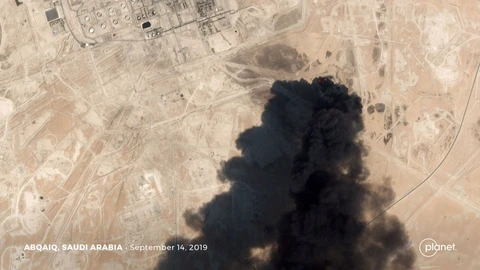
Figure 1. Extent of damage to Saudi Arabia Abqaiq infrastructure. Source: U.S. Government/DigitalGlobe, via Associated Press.

Can the SPR and Producers Meet Global Demand?

The flexibility of existing producers to increase output and put to work spare capacity is being tested under the current conditions. Additionally, the capacity to extract the oil stored by the Strategic Petroleum Reserve (SPR) and treat it quickly will also determine how fast the market recovers from the drone attack and its long term effect on oil prices.

Q2 Technologies Supports Emergency H2S Removal

Q2 Technologies regrets the damage on Aramco’s facilities and is ready to help treat oil to remove H2S with Pro3®.  Contact us today to discuss how we can help you treat any stored stocks or how to treat your oil at the wellhead.


Q2 Technologies has specialized in providing solutions to remove H2S from crude oil and natural gas for over 30 years. Until 2014, Q2 Technologies was elected as the subcontractor responsible for H2S removal technologies in the SPR. Q2 Technologies has helped American producers export billions of dollars worth of crude oil by removing hydrogen sulfide. Through industry collaboration America can help the world economy recover from this terrible attack. The new Pro3® chemistry is an important contribution to the industry as it addresses hydrogen sulfide issues as well as the operational concerns triggered by traditional triazine scavengers.

Let’s Work Together to Strengthen the Industry

Now is the time for everyone in the industry to work together and recover from this unfortunate blow. Visit Feedspot for other Oil and Gas blogs and learn what they are doing during this terrible time.

Drone Strike on Saudi Oil Facility Shakes Global Supply

Saudi Arabia’s all important Abqaiq processing facility was attacked with drones over the weekend shutting about 5% of global crude output as shown on Figure 1.

Global Oil Prices Surge After the Attack

Oil prices already surged while Saudi Aramco’s sources declared that it might take months for Saudi oil production to return to normal. This is a game changer for crude prices. West Texas Intermediate crude for October delivery (CLV19) was up 11.5% on Monday. On at $61.18 a barrel, hitting a session high of $63.34 a barrel. Brent crude prices for November delivery (BRNX19.L) the global benchmark, initially shot up 18% as trading began late Sunday. That gain pared to a rise of $7.16, or 12%, to $67.42 a barrel on Monday.

Figure 1. Extent of damage to Saudi Arabia Abqaiq infrastructure. Source: U.S. Government/DigitalGlobe, via Associated Press.

International Community Responds to Outage

The giant Saudi plant that was struck cleans crude oil of impurities, a necessary step before it can be exported and fed into refineries. The attack cut Saudi output by 5.7 million barrels a day, or around half its production. Big countries such as the United States and China have reserves designed to handle even a major outage over the short term. President Trump already announced that he would release US emergency supplies and producers around the world said that there are enough reserves to make up for the shortfall.

Long-Term Risks for Global Oil Markets

However, traders worry about the long-term price increase in oil to reflect how global supply can be hit sharply, overnight, and without warning. The vulnerability of the Middle East facilities and the sudden elimination of spare capacity have been exposed during these unstable times in the region as shown in Figure 2. Similarly, the broader market will assess how fast other suppliers can respond to the oil shortage and it is important to watch how quickly America’s shale can ramp up.

Figure 1. Extent of damage to Saudi Arabia Abqaiq infrastructure. Source: U.S. Government/DigitalGlobe, via Associated Press.

Can the SPR and Producers Meet Global Demand?

The flexibility of existing producers to increase output and put to work spare capacity is being tested under the current conditions. Additionally, the capacity to extract the oil stored by the Strategic Petroleum Reserve (SPR) and treat it quickly will also determine how fast the market recovers from the drone attack and its long term effect on oil prices.

Q2 Technologies Supports Emergency H2S Removal

Q2 Technologies regrets the damage on Aramco’s facilities and is ready to help treat oil to remove H2S with Pro3®.  Contact us today to discuss how we can help you treat any stored stocks or how to treat your oil at the wellhead.


Q2 Technologies has specialized in providing solutions to remove H2S from crude oil and natural gas for over 30 years. Until 2014, Q2 Technologies was elected as the subcontractor responsible for H2S removal technologies in the SPR. Q2 Technologies has helped American producers export billions of dollars worth of crude oil by removing hydrogen sulfide. Through industry collaboration America can help the world economy recover from this terrible attack. The new Pro3® chemistry is an important contribution to the industry as it addresses hydrogen sulfide issues as well as the operational concerns triggered by traditional triazine scavengers.

Let’s Work Together to Strengthen the Industry

Now is the time for everyone in the industry to work together and recover from this unfortunate blow. Visit Feedspot for other Oil and Gas blogs and learn what they are doing during this terrible time.

When introduced into a stream afflicted with H2S, the hemiformal decomposes to release formaldehyde, which then reacts with hydrogen sulfide to form stable, non-volatile byproducts such as thiomethylene glycol.  The reaction is typically fast and efficient, particularly in aqueous or mixed-phase environments. Unlike some traditional scavengers, hemiformal can maintain activity across a broad pH range and is less likely to generate problematic solids. When considering if hemiformal is the right product, certain operating conditions are reviewed, such as pH and temperature.

Heading 1

When introduced into a stream afflicted with H2S, the hemiformal decomposes to release formaldehyde, which then reacts with hydrogen sulfide to form stable, non-volatile byproducts such as thiomethylene glycol.  The reaction is typically fast and efficient, particularly in aqueous or mixed-phase environments. Unlike some traditional scavengers, hemiformal can maintain activity across a broad pH range and is less likely to generate problematic solids. When considering if hemiformal is the right product, certain operating conditions are reviewed, such as pH and temperature.

Heading 2

When introduced into a stream afflicted with H2S, the hemiformal decomposes to release formaldehyde, which then reacts with hydrogen sulfide to form stable, non-volatile byproducts such as thiomethylene glycol.  The reaction is typically fast and efficient, particularly in aqueous or mixed-phase environments. Unlike some traditional scavengers, hemiformal can maintain activity across a broad pH range and is less likely to generate problematic solids. When considering if hemiformal is the right product, certain operating conditions are reviewed, such as pH and temperature.

Heading 3

Heading 4

When introduced into a stream afflicted with H2S, the hemiformal decomposes to release formaldehyde, which then reacts with hydrogen sulfide to form stable, non-volatile byproducts such as thiomethylene glycol.  The reaction is typically fast and efficient, particularly in aqueous or mixed-phase environments. Unlike some traditional scavengers, hemiformal can maintain activity across a broad pH range and is less likely to generate problematic solids. When considering if hemiformal is the right product, certain operating conditions are reviewed, such as pH and temperature. 

Key Benefits:

  • Controlled formaldehyde release 
  • Lower vapor pressure and improved safety profile 
  • Broad applicability across liquid and gas-phase systems 
  • Reduced scaling in sour water stripping and other high-temp operations 
  • Hemiformal can make the scavenger safe for transport as it is a very stable compound 

Heading 5

Hemiformal is used in a variety of upstream and midstream applications, including: 

  • Gas sweetening systems 
  • Produced water treatment 
  • Crude oil storage and transport 
  • Sour water stripper overheads 
  • Temporary H2S mitigation during maintenance or turnaround

Its adaptability makes it especially useful in operations where system conditions fluctuate or where traditional triazine-based products may underperform. 

Heading 6

While hemiformal offers many advantages, it is not a one-size-fits-all solution. The rate of formaldehyde release can vary depending on formulation and environmental conditions. Additionally, while safer than raw formaldehyde, hemiformal must still be handled with care and appropriate PPE. 

For optimal results, formulation expertise and application-specific customization are key—something we at Q2 Technologies excel at delivering. 

Related Blogs

Related Articles