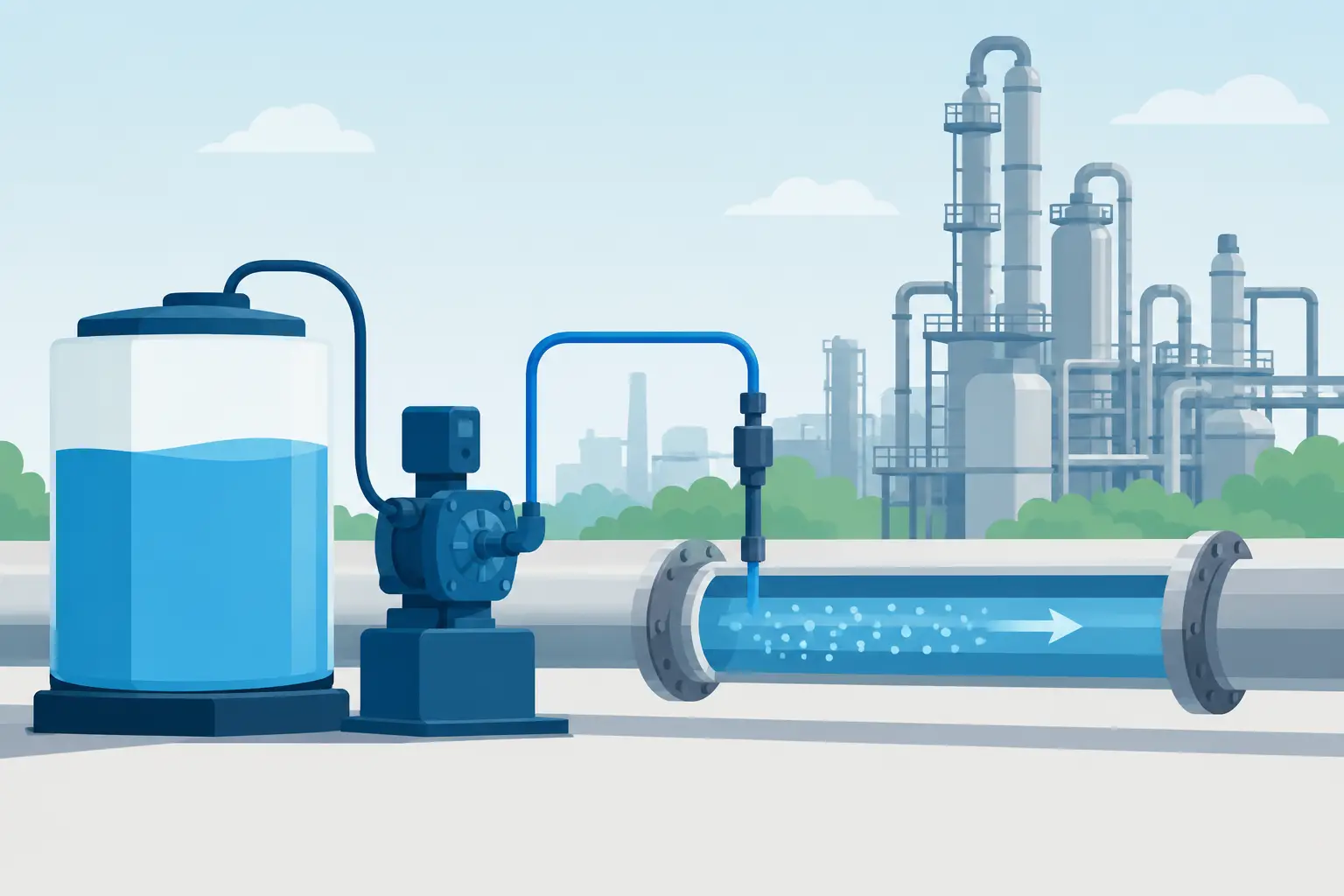


Operators treating H2S in natural gas generally choose between solid metal oxide beds, most commonly iron oxide or zinc oxide media, and liquid scavengers such as triazine injected directly into the gas stream. Both approaches are proven and widely used, but they perform differently depending on gas rate, H2S concentration, moisture content, and available infrastructure, and choosing between them is less about which chemistry is superior and more about which fits the specific application.

Metal oxide media removes H2S through a solid-gas reaction, converting H2S into a metal sulfide as gas passes through a fixed bed. This approach tends to work best at lower to moderate gas flow rates and H2S concentrations, where the bed can be sized to provide adequate contact time without becoming impractically large. Iron oxide systems in particular require a minimum moisture content in the gas stream to sustain the reaction, since the chemistry depends on a thin water film on the media surface; gas that is too dry can see sharply reduced removal efficiency even with fresh media in place.
Bed-based systems require periodic media replacement or regeneration, along with vessel space and personnel time for changeouts, which becomes a larger consideration as gas volume and H2S loading increase and media life shortens correspondingly.
How Liquid Scavengers Work
Liquid scavengers like triazine are injected directly into the gas stream, typically as a fine spray or through an atomizing nozzle, and react with H2S as the two phases contact. This approach scales more easily to higher gas volumes than a fixed bed, since chemical injection rate can be adjusted continuously rather than requiring a change in vessel size, but it introduces its own considerations around adequate contact time, spent chemical disposal, and the dithiazine byproduct management discussed elsewhere in H2S treatment literature.
Liquid scavengers generally do not carry the same moisture dependency as iron oxide, which makes them a more straightforform choice for drier gas streams where a metal oxide bed would underperform.
Decision Factors Worth Weighing
Gas rate and H2S concentration are the starting point: high volume, high H2S streams typically favor liquid scavenger injection due to scalability, while lower volume, lower H2S streams are often well suited to a metal oxide bed with manageable changeout intervals. Moisture content is the next major factor, since dry gas favors liquid scavenger while adequately moist gas can support either approach.
Available infrastructure and personnel also matter. Facilities with existing chemical injection systems and staff familiar with liquid scavenger handling may find that route more practical, while remote or minimally staffed locations sometimes prefer the lower-touch nature of a solid bed that only requires attention at changeout intervals.
There Is No Universal Answer
The right chemistry for a given wellhead or gathering point comes down to matching the treatment method to the specific gas composition and operating conditions at that location, rather than defaulting to whichever chemistry is already in use elsewhere in the field. A short gas analysis, including moisture content alongside H2S concentration, is usually enough information to make a well-informed choice between the two approaches.
Cost Comparisons Over Time
Upfront cost comparisons between metal oxide and liquid scavenger systems can be misleading if they only account for initial installation. Metal oxide systems carry relatively low upfront cost but recurring media replacement expense that scales with H2S loading and gas volume, while liquid injection systems require more initial capital for pumps and storage but can offer lower incremental cost per unit of H2S removed at higher volumes. Building a cost model across the expected operating life of the facility, rather than comparing quotes for the initial installation alone, generally gives a more accurate picture of which approach is more economical for a specific application.
Combining Both Approaches
Some facilities use both technologies in sequence, running a liquid scavenger as a primary treatment stage and a smaller metal oxide polishing bed downstream to capture any breakthrough H2S before the gas reaches sales specification. This combined approach can offer a useful safety margin in situations where consistent, tight H2S specification compliance is critical and the cost of an occasional excursion outweighs the added expense of maintaining two treatment stages.
Accounting for Future Production Changes
A treatment system selected for today’s gas composition may not remain the best fit as a well or field matures. H2S concentration and gas rate both tend to change over the life of a well, and a metal oxide bed sized for early-life conditions can become undersized as H2S loading increases, while a liquid injection system built for high early volumes may end up oversized as production declines. Reviewing treatment technology choice periodically, rather than only at initial installation, helps operators catch these shifts before they become a compliance or cost problem.