


A mercaptan problem rarely announces itself as a single number on a lab report. It shows up as persistent odor, a failed sales-gas specification, a refinery blend constraint, elevated corrosion risk, or customer complaints about product quality. The best options for mercaptan sweetening depend on what must be controlled: mercaptan concentration, total sulfur, odor intensity, corrosivity, or a combination of all four.
That distinction matters because sweetening and removal are not interchangeable. Some processes oxidize mercaptans into disulfides, reducing odor and corrosive behavior while leaving sulfur in the hydrocarbon phase. Other approaches extract, adsorb, or react with mercaptans to reduce total mercaptan content. Selecting the wrong treatment basis can create a technically successful process that still leaves the stream off spec.
Start With the Actual Treatment Objective
Mercaptans, also called thiols, occur in natural gas, NGLs, condensate, crude oil, refinery streams, biogas, and certain industrial liquid streams. Their behavior varies widely by molecular weight, stream phase, pressure, temperature, and the presence of H2S, carbon dioxide, water, oxygen, and hydrocarbons.
Before selecting chemistry or equipment, operators should establish the required outlet condition. A pipeline gas stream may require lower total sulfur or mercaptan sulfur. A condensate or LPG stream may need improved odor quality and copper-strip performance. A crude oil application may focus on mitigating odor during storage, transport, or loading. In each case, the treatment method must align with the governing specification and how performance will be measured.
Feed characterization is equally important. Total mercaptans alone do not tell the full story. Light mercaptans such as methyl mercaptan and ethyl mercaptan behave differently from heavier mercaptans. A stream with dissolved H2S may require a combined sulfur-control strategy, while water content and hydrocarbon composition can determine whether a liquid-phase reaction, extraction system, or fixed-bed media is practical.
Best Options for Mercaptan Sweetening by Application
Caustic extraction and catalytic oxidation
For refinery and gas-processing applications with sustained flow rates and relatively consistent feed composition, caustic-based extraction followed by catalytic oxidation is a proven sweetening route. In these systems, mercaptans are transferred from the hydrocarbon into a caustic phase and oxidized to disulfides. Depending on the configuration, disulfides may be separated and removed or managed within the process.
This approach is often effective for LPG, light hydrocarbons, and selected refinery streams where established infrastructure, utility availability, and trained operating support are in place. It can deliver reliable treatment at scale, especially when the objective is reducing mercaptan sulfur to a defined product specification.
The trade-off is operational complexity. Caustic systems require careful control of strength, circulation, oxidation conditions, disulfide handling, and wastewater or spent-caustic management. They are generally less attractive for remote facilities, variable production profiles, or applications where installing and maintaining a dedicated treatment unit is not justified.
Fixed-bed adsorption and reactive media
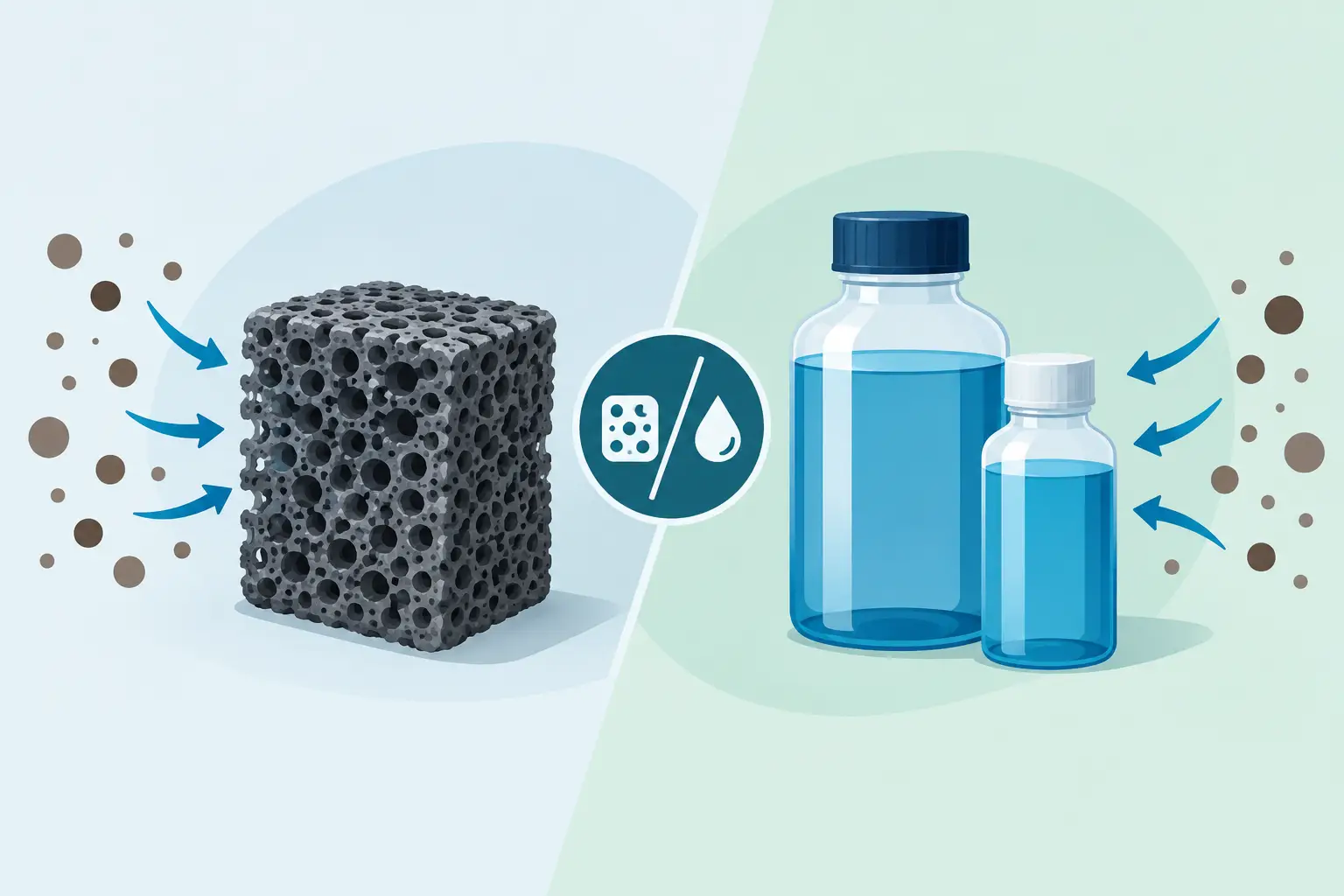
Fixed-bed systems use adsorbents or reactive media to capture or convert sulfur compounds as the stream passes through a vessel. They can be useful for lower-volume gas streams, polishing duty, intermittent service, or sites with limited operator attention. Depending on the media and operating conditions, these systems may address mercaptans, H2S, or both.
The principal benefit is simplicity at the point of use. A properly designed vessel can provide predictable performance without continuous chemical injection. However, bed life is highly dependent on inlet loading, moisture, temperature, flow variation, competing contaminants, and breakthrough criteria. A media solution that performs well in a dry, stable gas stream may lose capacity quickly when exposed to condensate, oil carryover, or changing sulfur speciation.
Fixed beds also require a realistic changeout plan. Operators should account for vessel access, spent-media classification, disposal requirements, contingency inventory, and the pressure-drop consequences of long service intervals. For critical service, outlet monitoring is needed to avoid treating breakthrough as a surprise event.
Hydrotreating and hydroprocessing
Hydrotreating is frequently the right choice when mercaptan treatment must be integrated with broader refinery upgrading or when deep sulfur removal is required. Hydrogen converts sulfur species into H2S, which is then removed downstream through amine treating, stripping, or another sulfur-removal process.
This route can provide high-quality finished products and address a broad range of sulfur compounds beyond mercaptans. It is particularly relevant when a product must meet stringent sulfur specifications rather than simply improve odor or doctor-test performance.
Its limitations are equally clear. Hydrotreating requires capital equipment, hydrogen, catalyst management, heat integration, and experienced operations. It is not a field-deployable answer for a remote tank battery or a short-duration upset. It is a refinery-scale processing decision that should be evaluated against product value, existing unit capacity, and the full sulfur balance.
Liquid scavengers and application-specific reaction chemistry
Liquid chemical treatment can be a practical option where permanent processing equipment is unavailable, stream conditions fluctuate, or rapid deployment is needed. Applied through continuous injection, batch treatment, circulation, or contact systems, scavenger chemistry can reduce mercaptan-related odor and sulfur risk in selected gas and liquid applications.
The key is matching chemistry to the stream and the treatment objective. A product that is effective in an aqueous, well-mixed environment may not perform the same way in dry gas, high-BTU hydrocarbon liquids, emulsions, or systems with limited contact time. Reaction products must also be considered. Treatment should not create solids, emulsions, residual odor, or disposal challenges that cost more than the original mercaptan issue.
For field applications, liquid treatment is strongest when it is supported by injection-point design, representative sampling, dose control, and routine performance verification. Q2 Technologies’ ProM® mercaptan treatment products are designed for this type of application-specific approach, where chemistry is paired with field execution rather than treated as a one-size-fits-all commodity.
Oxidation and odor-control programs
In wastewater, landfill gas, biogas, tank vents, and industrial odor applications, the immediate concern may be mercaptan odor rather than hydrocarbon product specifications. Oxidation-based treatment, vapor-phase control, wet scrubbing, and targeted odor-control chemistry can be effective when they are designed around the actual sulfur compounds present.
These programs require special attention to residence time, pH, oxygen availability, humidity, temperature, and mass transfer. Mercaptans can be detected by odor at extremely low concentrations, so a treatment system that substantially lowers bulk sulfur may still fail community or workplace odor expectations. Site-specific sampling and odor-response testing are often more valuable than relying solely on total sulfur data.
How to Compare Technologies Without Oversimplifying the Decision
The lowest quoted chemical price or equipment cost is rarely the lowest treatment cost. Operators should compare options on a delivered-performance basis: cost per pound of mercaptan treated, outlet reliability, labor requirements, waste generation, supply continuity, safety exposure, and the cost of an off-spec event.
Contact time is a common source of underperformance. Whether using scavenger injection, a contactor, a fixed bed, or an oxidation system, the chemistry needs sufficient opportunity to reach the target reaction or transfer equilibrium. High flow rates, poor mixing, phase separation, and short residence times can make a theoretically sound treatment underperform in the field.
Monitoring closes the gap between design and operations. Regular inlet and outlet testing identifies changes in mercaptan loading before product quality is affected. For continuously treated systems, chemical usage should be reviewed against flow, sulfur load, and measured outlet results. A rising treatment rate without a corresponding change in feed conditions may point to poor injection, equipment fouling, changed speciation, or sampling error.
Build the Treatment Program Around Field Reality
Mercaptan sweetening succeeds when process design, chemistry, logistics, and operating discipline work together. A refinery unit may justify a permanent extraction or hydrotreating solution. A remote gas or condensate operation may be better served by targeted chemical treatment with optimized injection and dependable replenishment. A landfill or wastewater facility may need an odor-control program built around vapor conditions and community sensitivity rather than a conventional hydrocarbon sweetening model.
The practical next step is to define the outlet requirement, characterize the sulfur species, and test the selected approach under representative conditions. That process turns mercaptan treatment from a recurring operating problem into a controlled, measurable part of the operation.
Q2 Technologies supports LNG facilities with acid gas treatment chemistries designed to remove hydrogen sulfide and carbon dioxide ahead of liquefaction. Consistent gas purity is critical to LNG processing, and Q2’s proprietary formulations are built to meet those exacting standards. Facility operators trust Q2’s decades of sour gas treatment experience to help maintain smooth, compliant operations. Visit Q2Technologies.com to learn more about our LNG acid gas treatment solutions.