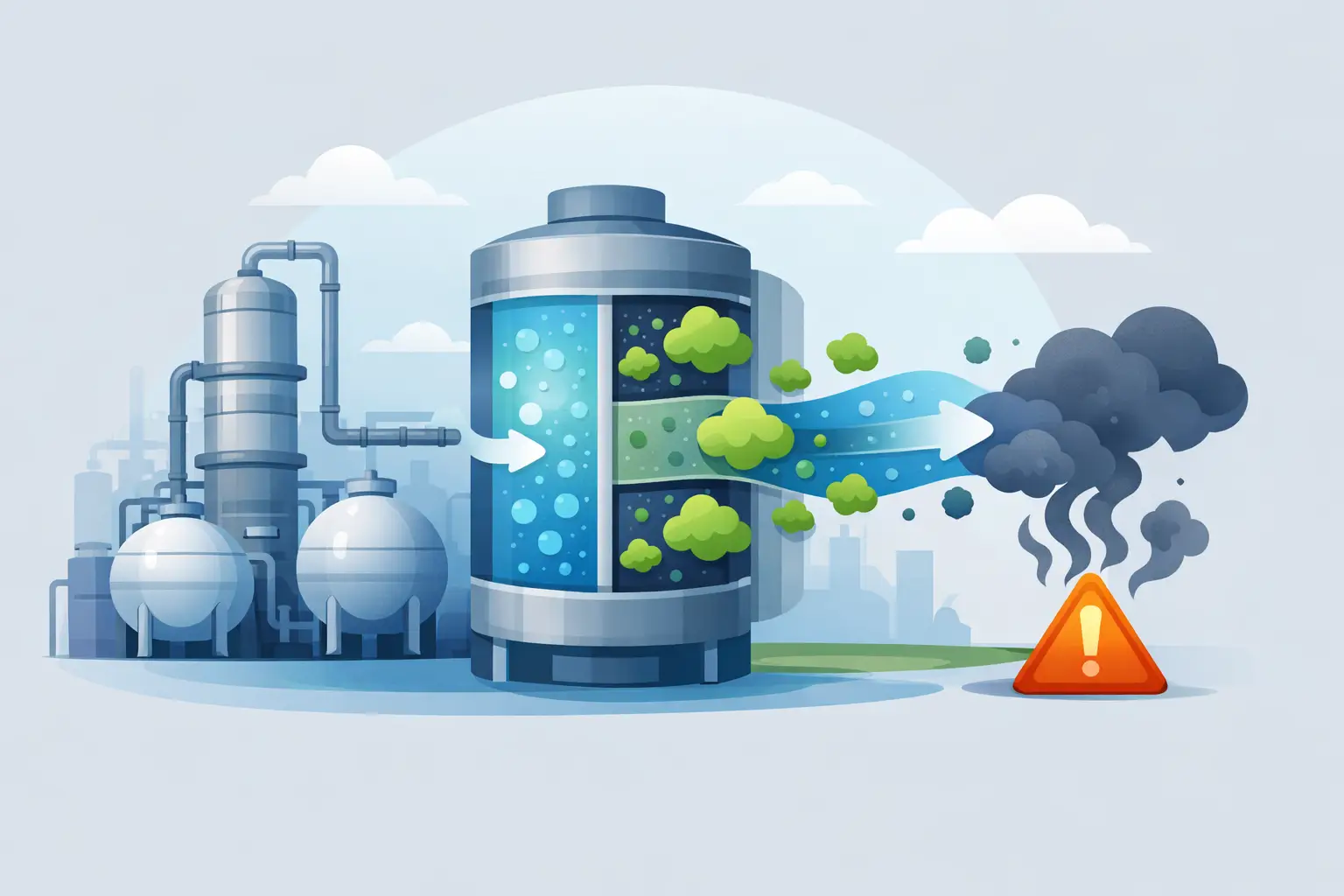
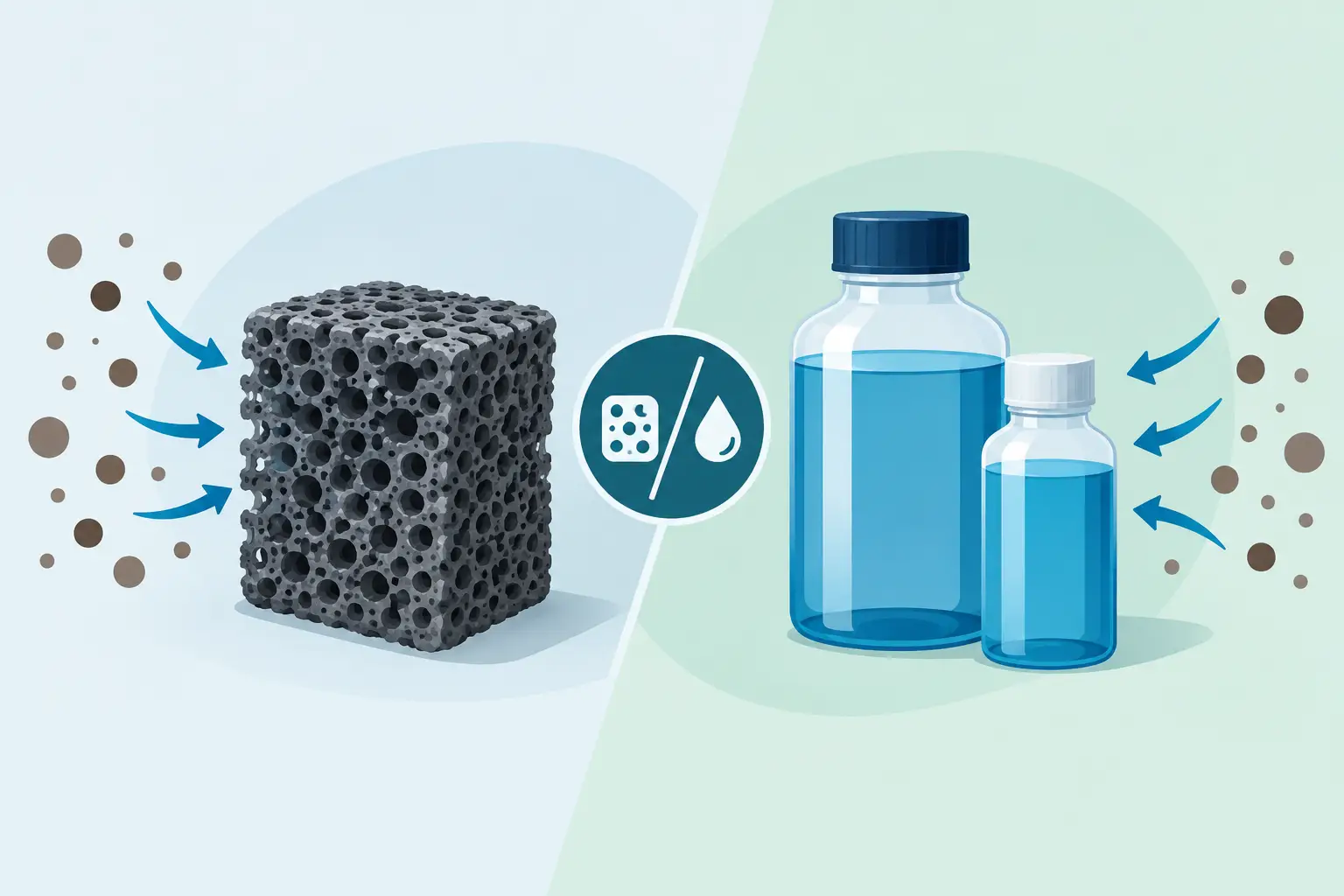


A treatment failure rarely starts as a chemistry problem. It starts when an H2S removal system is selected around a single variable – usually purchase price or nameplate capacity – while the actual stream, operating profile, and disposal constraints receive less attention. The iron sponge versus liquid scavengers decision should be based on how sulfur enters the system, where treatment must occur, and what happens after H2S is removed.
Iron sponge media and liquid scavengers can both reduce H2S effectively in the right service. They operate very differently, however. One relies on a fixed bed of reactive solid media; the other is injected into a gas or liquid stream and reacts with H2S in process. The practical differences affect uptime, labor, waste handling, chemical consumption, and the ability to respond when inlet conditions change.
Iron Sponge Versus Liquid Scavengers: The Operating Difference
Iron sponge is a solid-phase H2S treatment approach commonly associated with iron oxide-coated media, often supported on wood-based material or other substrates. Sour gas passes through a vessel containing the media, where H2S reacts with iron oxide to form iron sulfide. Proper bed design, gas distribution, moisture control, and residence time are central to performance.
The arrangement can be straightforward: install a vessel, route gas through the bed, and monitor outlet H2S until the media approaches exhaustion. That simplicity can be attractive for relatively steady, lower-volume gas streams where there is adequate footprint and scheduled vessel service is acceptable.
Liquid scavengers are chemical formulations injected upstream of a point where mixing and reaction can occur. In many oil and gas applications, triazine-based products are used to treat H2S in natural gas, crude oil, produced water, or multiphase streams. The scavenger reacts with H2S, producing sulfur-containing reaction products that must be managed within the process or removed downstream.
This model allows treatment to be applied at a wellsite, gathering line, tank battery, pipeline, separator, or other location where a fixed bed may not be practical. It also makes treatment rate adjustable. When inlet H2S rises, production changes, or operating conditions shift, injection can be modified rather than waiting for a media changeout.
Neither approach is automatically the lower-cost option. A media system may have a lower day-to-day operating burden in stable service but carry significant changeout and disposal costs. Liquid treatment may avoid a large vessel installation, yet its performance depends on injection accuracy, mixing, contact time, and the behavior of reaction products in the system.
When Iron Sponge Is a Strong Fit
Iron sponge is often considered when the stream is gaseous, flow and H2S loading are reasonably predictable, and the operator can accommodate a treatment vessel. It can be particularly suitable when a site has enough room for bed vessels and planned maintenance windows do not create unacceptable operational risk.
A fixed-bed system does not require continuous chemical delivery to maintain treatment. For remote facilities with limited power, automation, or tank access, that can be a meaningful advantage. Once the system is properly sized and commissioned, operators can focus on differential pressure, outlet H2S, moisture conditions, and remaining bed life.
The limitation is that bed capacity is finite. A sudden increase in H2S concentration, gas volume, or moisture behavior can consume media faster than expected. If the bed reaches breakthrough before a replacement is available, the facility may face off-spec gas, increased corrosion risk, odor issues, or curtailment.
Spent iron sponge also requires a clear handling plan. Iron sulfide-bearing media can present safety concerns, including the potential for heat generation or pyrophoric behavior when exposed to air under certain conditions. Site procedures for isolation, removal, wetting where appropriate, packaging, transportation, and disposal should be established before the initial fill, not when the vessel is spent.
Iron sponge performance also depends on gas condition. Variations in humidity, condensate carryover, oxygen exposure, particulate loading, and channeling can all affect usable capacity. A bed that looks adequate on a sizing sheet may underperform if gas distribution is poor or real-world conditions differ from the design basis.
Where Liquid Scavengers Provide More Control
Liquid scavengers are generally better suited to variable operations, constrained locations, and treatment points where injection can be integrated into existing infrastructure. They are commonly used where H2S concentration changes with well behavior, production rate, water cut, temperature, or blending activity.
The primary operational advantage is adjustability. An operator can set a treatment rate based on measured H2S loading, then optimize against outlet results and process conditions. That does not mean more chemical is always the answer. Overfeeding can raise cost and contribute to downstream issues, while underfeeding can leave H2S untreated. The objective is to deliver the required chemistry at the right point, in the right amount, with enough mixing and contact time to react.
Injection location matters as much as the product selection. A scavenger introduced into a line with poor turbulence or limited residence time may not achieve expected H2S reduction before the stream reaches a sales point, compressor, tank, or downstream asset. In liquid systems, phase behavior is equally important. The chemistry must reach the phase where the H2S is present and remain compatible with the operating environment.
Reaction byproducts require attention. Depending on the chemistry and application, liquid scavenger use can contribute to solids, deposits, emulsions, foaming, or downstream treatment load if the program is not designed for the system. These risks do not eliminate liquid treatment, but they make field evaluation essential. A treatment plan should account for separators, filters, produced-water handling, pipelines, and disposal routes rather than evaluating H2S removal in isolation.
Cost Should Be Measured by Treated Sulfur, Not Unit Price
Comparing a drum of scavenger with a ton of media does not produce a useful cost comparison. The relevant measure is the total cost to keep H2S at the required specification while protecting operations.
For iron sponge, that includes vessel capital or rental, media loading, expected bed life, labor, pressure drop, monitoring, changeout logistics, disposal, and the consequence of unplanned breakthrough. For liquid scavengers, it includes delivered chemistry, storage, injection equipment, monitoring, maintenance, chemical utilization, reaction-product management, and delivery reliability.
A program with the lowest chemical price can still be expensive if it requires excessive treatment rates or causes downstream fouling. Likewise, a media bed with a favorable initial quote can become costly if variable inlet loading shortens its service interval and forces emergency changeouts.
The right comparison starts with sulfur mass loading. Calculate or estimate H2S concentration, flow rate, pressure, temperature, gas or liquid composition, and expected variability. Then establish the outlet specification and the consequences of exceeding it. This creates a basis for comparing treatment capacity and consumption under actual operating conditions rather than nominal assumptions.
Data That Changes the Selection
The most productive evaluation is usually site-specific. A few inputs can quickly determine whether fixed media, liquid scavenger injection, or a combined approach deserves consideration.
First, determine whether H2S is in gas, liquid, or both. A gas-only stream with stable composition has different treatment options than a multiphase production stream where H2S partitions between hydrocarbon, water, and vapor phases. Next, look at variability. Daily swings, slugging, production declines, and changing well mix favor a treatment method that can respond without major physical intervention.
Available infrastructure matters as well. A pad may have no practical room for vessels but enough space for a chemical tote and injection skid. Another facility may have established vessel handling capability but limited access for recurring chemical deliveries. In either case, logistics is part of treatment performance. A technically sound program still fails if fresh media, chemical supply, monitoring support, or replacement equipment cannot reach the site when needed.
Finally, identify downstream sensitivity before treatment begins. Compressor protection, pipeline specifications, amine systems, sulfur recovery equipment, produced-water facilities, and waste vendors may all influence the best chemistry and treatment location.
Building a Treatment Program That Holds Up in the Field
The strongest H2S control programs pair chemistry with verification. Outlet testing, inlet trending, injection-rate records, differential-pressure monitoring for media beds, and observation of downstream conditions turn treatment from a reactive expense into a controlled operating system.
For liquid programs, this means confirming actual H2S loading and validating that the injection point provides adequate dispersion and residence time. For iron sponge, it means tracking bed performance early enough to plan changeouts instead of reacting to breakthrough. Both methods benefit from field support that connects treatment data to operating decisions.
Q2 Technologies approaches sulfur treatment as an application problem, not a one-size-fits-all chemical purchase. The useful question is not whether iron sponge or liquid scavenger is universally better. It is which approach can consistently meet specification at your site while minimizing disruption, waste, corrosion exposure, and avoidable chemical spend.