

A sulfur treatment problem rarely announces itself as a chemistry problem first. It shows up as elevated H2S at a tank vent, mercaptan odor near a loading rack, accelerated corrosion in a wet system, an off-spec hydrocarbon stream, or a treatment chemical budget that keeps rising without a clear performance gain. Effective refinery sulfur solutions address the sulfur species, the process conditions, and the execution details that determine whether treatment performs consistently.

For refinery operators, the objective is not simply to add a scavenger and obtain a favorable spot sample. The objective is to control sulfur-related risk without disrupting throughput, creating downstream handling issues, or consuming more chemistry than the application requires. That calls for a treatment program built around field data, appropriate chemical selection, reliable injection, and ongoing adjustment.

Why Sulfur Control Is a Refinery Operations Issue

Hydrogen sulfide and mercaptans create different operational concerns, but both can affect safety, equipment integrity, product quality, and community relations. H2S is acutely toxic and can be present in crude oil, sour water, vapor spaces, produced intermediates, and slop systems. Where moisture and oxygen conditions support corrosion mechanisms, sulfides can also contribute to asset damage and maintenance exposure.

Mercaptans often receive attention because of odor, but their impact extends beyond nuisance conditions. Depending on the hydrocarbon stream and specification, mercaptans can contribute to product-quality concerns, handling limitations, and customer complaints. A treatment approach that reduces total sulfur without addressing the specific odor-active mercaptan fraction may not resolve the practical problem.


The challenge is compounded by process variability. Crude source changes, blend ratios, temperature, pressure, water cut, residence time, and flow rate can shift treatment demand quickly. A program that worked under one operating condition may underperform after a change in feedstock or operating rate. That is why refinery sulfur control requires more than a static dosage target.

Matching Refinery Sulfur Solutions to the Stream

The first technical question is straightforward: what sulfur species must be controlled, and where are they present? The operational answer is usually more involved. A refinery may be managing sulfur in crude storage, vapor recovery, wastewater, tank headspace, fuel blending, or intermediate liquid streams. Each location has different contact conditions, constraints, and measurement methods.


Liquid-phase H2S treatment depends heavily on mixing and contact time. A chemical injected into a flowing hydrocarbon stream must disperse effectively and remain in contact with the target sulfur compound long enough to react. In a tank application, treatment may require a different injection strategy because stratification, vapor-liquid equilibrium, agitation, and turnover rate affect results.


Vapor-phase applications require their own evaluation. H2S partitioning between liquid and vapor can create a misleading result when only one phase is measured. Lowering H2S in the liquid may reduce vapor exposure, but it may not provide sufficient control if vapor space conditions or agitation continue to release H2S. Treatment planning should therefore consider both the location of the sulfur and the location where risk is measured.


Mercaptan treatment also requires specificity. The chemistry that performs well against H2S is not automatically the best option for mercaptan reduction. Operators should evaluate the relevant mercaptan species, stream composition, required specification, phase behavior, and downstream compatibility. The right treatment chemistry is application-dependent, not a commodity selection.

Treatment Performance Is More Than Reaction Rate

Fast reaction kinetics can be valuable, especially where residence time is limited. But reaction speed alone does not define a successful treatment program. The resulting spent chemistry or reaction products must be manageable within the facility’s operating and disposal framework. Chemical compatibility with hydrocarbons, water systems, metallurgy, and downstream processes also matters.


A lower-cost product can become expensive if it requires excessive dosage, creates separation difficulties, contributes to fouling, or produces inconsistent results during feed changes. Conversely, a higher-performance chemistry may lower total treatment cost when it reduces consumption, minimizes re-treatment, and protects uptime. The proper comparison is cost per treated unit at the required control point, not price per gallon.

Injection and Mixing Determine Chemical Efficiency

Many sulfur-treatment shortfalls originate at the injection point rather than in the chemistry. A properly selected scavenger cannot compensate indefinitely for poor dispersion, insufficient contact time, intermittent pumping, or a line location that does not represent the actual process stream.


Injection equipment should be sized for the expected flow range and capable of maintaining stable delivery at low and high operating rates. The injection point should support adequate mixing without creating operational problems such as localized chemical concentration, plugging, or incompatible contact with other additives. Where flow is variable, an automated approach that adjusts chemical delivery with process conditions can reduce both under-treatment and unnecessary consumption.


Treatment verification should also be placed where it can support decisions. A sample point immediately downstream of injection may show early chemical response, while a point after meaningful residence time indicates whether the application is meeting the actual treatment objective. When only one measurement point is used, it should be selected based on the control target, not convenience.


For continuous applications, field personnel should review dosage, flow, sulfur readings, and chemical inventory together. A sulfur result without flow context does not establish treatment efficiency. Likewise, chemical usage without a reliable sulfur measurement cannot distinguish process demand from injection or monitoring issues.

Monitoring Turns Treatment Into a Controlled Process

Manual testing remains useful for confirmation and troubleshooting, but periodic grab samples can miss short-duration H2S excursions and changing process conditions. Continuous or frequent monitoring provides a clearer picture of treatment performance, particularly in applications with variable feed, batch operations, tank turnover, or changing ambient conditions.


The value of monitoring is not limited to compliance documentation. Trending reveals whether a dosage change improved performance, whether a new crude blend increased sulfur demand, and whether a pump or injection system has drifted from its expected output. It can also identify when a result is tied to an operational event rather than a chemical failure.


A practical monitoring plan uses fit-for-purpose methods. The required detection range, sample matrix, response time, maintenance needs, and data accessibility should match the risk at the site. High-frequency data is useful only when operations have clear responsibilities for reviewing it and acting on deviations.

Managing the Trade-Offs in Sulfur Treatment

There is no universal best refinery sulfur treatment program. Higher treatment rates may provide a larger operating margin, but they can increase chemical spend and spent-material handling. A lower dosage can reduce cost, but it may leave too little margin for a feed excursion. The appropriate balance depends on the safety threshold, product specification, process variability, and consequence of an upset.


Operators should also avoid treating a single number as the entire performance standard. A favorable H2S result may coexist with odor complaints if mercaptans remain uncontrolled. A program may reduce vapor exposure while creating excessive chemical carryover in a liquid system. These are not necessarily chemistry failures. They are signals that the treatment objective, monitoring location, or application design needs adjustment.


Reliable supply is another operational variable. Continuous sulfur treatment applications can quickly become high-risk when chemistry inventory, delivery scheduling, tote changeout, or on-site storage is not managed to match consumption. Treatment design should include realistic inventory thresholds, backup planning, and field support requirements alongside chemical selection.

Building a Better Refinery Sulfur Control Program

A disciplined program begins with stream characterization and a clear definition of the control point. Determine whether the priority is personnel exposure, corrosion mitigation, odor reduction, product specification, or a combination of these needs. Then evaluate the sulfur species, concentration range, phase behavior, operating conditions, and downstream constraints.


From there, conduct a field-relevant treatment evaluation rather than relying only on laboratory response. Bench testing can help screen candidate chemistries, but field performance confirms mixing, residence time, interference effects, and actual demand. Establish baseline sulfur measurements and chemical consumption before changing multiple variables at once.


The most useful treatment programs include a regular review cadence. Operations, maintenance, environmental personnel, and the treatment provider should be able to assess trend data, inventory use, injection performance, and upcoming process changes together. That coordination helps prevent small deviations from becoming costly upsets.

Q2 Technologies approaches these applications as an integrated field problem: treatment chemistry must work with monitoring, injection optimization, and dependable delivery. For refinery teams, that integrated view is often where measurable efficiency gains are found.


The next time sulfur treatment demand changes, start by asking what changed in the process before increasing dosage. A focused review of stream conditions, injection performance, and measurement data can often identify a more durable correction than simply adding more chemical.

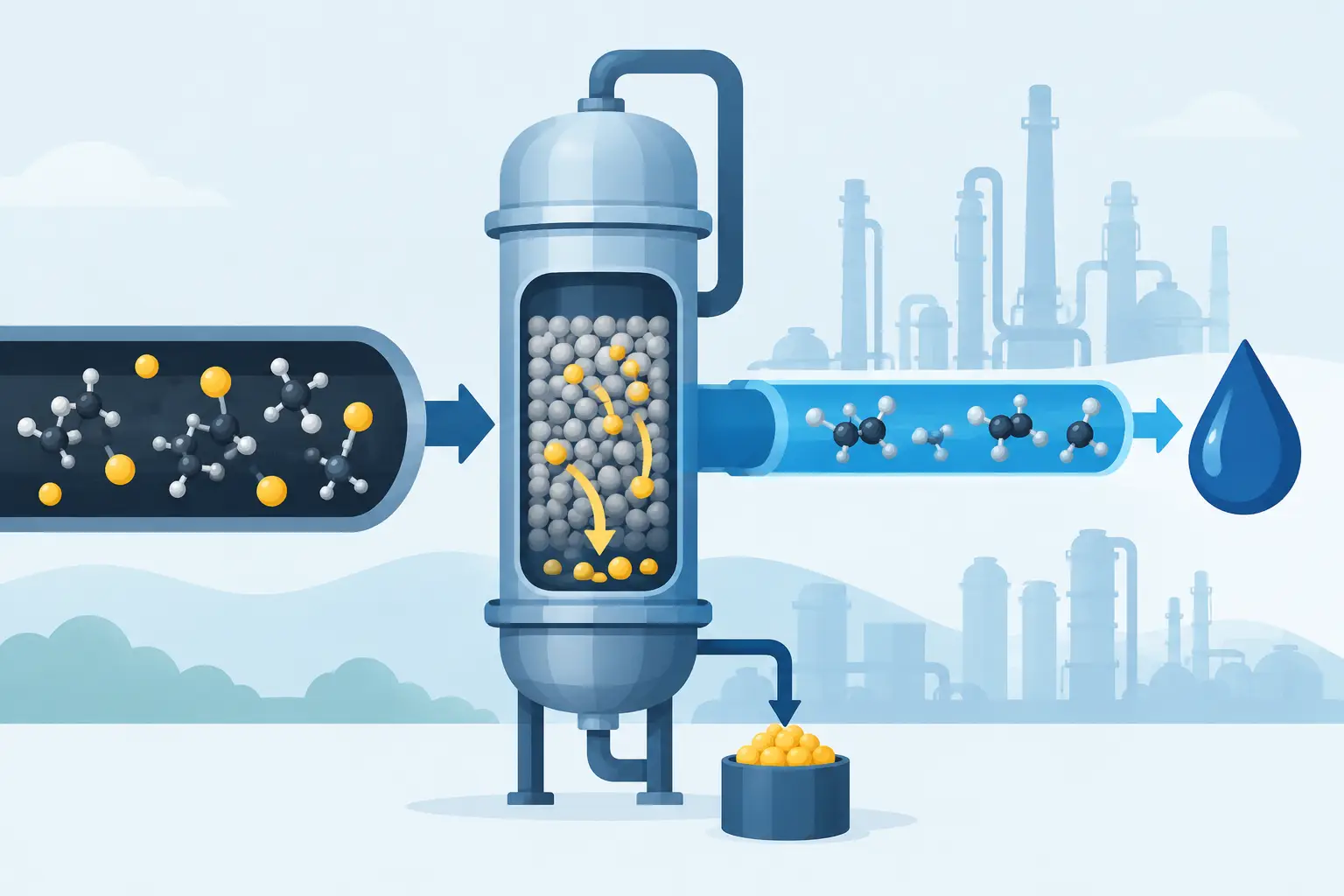
A sulfur treatment problem rarely announces itself as a chemistry problem first. It shows up as elevated H2S at a tank vent, mercaptan odor near a loading rack, accelerated corrosion in a wet system, an off-spec hydrocarbon stream, or a treatment chemical budget that keeps rising without a clear performance gain. Effective refinery sulfur solutions address the sulfur species, the process conditions, and the execution details that determine whether treatment performs consistently.

For refinery operators, the objective is not simply to add a scavenger and obtain a favorable spot sample. The objective is to control sulfur-related risk without disrupting throughput, creating downstream handling issues, or consuming more chemistry than the application requires. That calls for a treatment program built around field data, appropriate chemical selection, reliable injection, and ongoing adjustment.

Why Sulfur Control Is a Refinery Operations Issue

Hydrogen sulfide and mercaptans create different operational concerns, but both can affect safety, equipment integrity, product quality, and community relations. H2S is acutely toxic and can be present in crude oil, sour water, vapor spaces, produced intermediates, and slop systems. Where moisture and oxygen conditions support corrosion mechanisms, sulfides can also contribute to asset damage and maintenance exposure.

Mercaptans often receive attention because of odor, but their impact extends beyond nuisance conditions. Depending on the hydrocarbon stream and specification, mercaptans can contribute to product-quality concerns, handling limitations, and customer complaints. A treatment approach that reduces total sulfur without addressing the specific odor-active mercaptan fraction may not resolve the practical problem.


The challenge is compounded by process variability. Crude source changes, blend ratios, temperature, pressure, water cut, residence time, and flow rate can shift treatment demand quickly. A program that worked under one operating condition may underperform after a change in feedstock or operating rate. That is why refinery sulfur control requires more than a static dosage target.

Matching Refinery Sulfur Solutions to the Stream

The first technical question is straightforward: what sulfur species must be controlled, and where are they present? The operational answer is usually more involved. A refinery may be managing sulfur in crude storage, vapor recovery, wastewater, tank headspace, fuel blending, or intermediate liquid streams. Each location has different contact conditions, constraints, and measurement methods.


Liquid-phase H2S treatment depends heavily on mixing and contact time. A chemical injected into a flowing hydrocarbon stream must disperse effectively and remain in contact with the target sulfur compound long enough to react. In a tank application, treatment may require a different injection strategy because stratification, vapor-liquid equilibrium, agitation, and turnover rate affect results.


Vapor-phase applications require their own evaluation. H2S partitioning between liquid and vapor can create a misleading result when only one phase is measured. Lowering H2S in the liquid may reduce vapor exposure, but it may not provide sufficient control if vapor space conditions or agitation continue to release H2S. Treatment planning should therefore consider both the location of the sulfur and the location where risk is measured.


Mercaptan treatment also requires specificity. The chemistry that performs well against H2S is not automatically the best option for mercaptan reduction. Operators should evaluate the relevant mercaptan species, stream composition, required specification, phase behavior, and downstream compatibility. The right treatment chemistry is application-dependent, not a commodity selection.

Treatment Performance Is More Than Reaction Rate

Fast reaction kinetics can be valuable, especially where residence time is limited. But reaction speed alone does not define a successful treatment program. The resulting spent chemistry or reaction products must be manageable within the facility’s operating and disposal framework. Chemical compatibility with hydrocarbons, water systems, metallurgy, and downstream processes also matters.


A lower-cost product can become expensive if it requires excessive dosage, creates separation difficulties, contributes to fouling, or produces inconsistent results during feed changes. Conversely, a higher-performance chemistry may lower total treatment cost when it reduces consumption, minimizes re-treatment, and protects uptime. The proper comparison is cost per treated unit at the required control point, not price per gallon.

Injection and Mixing Determine Chemical Efficiency

Many sulfur-treatment shortfalls originate at the injection point rather than in the chemistry. A properly selected scavenger cannot compensate indefinitely for poor dispersion, insufficient contact time, intermittent pumping, or a line location that does not represent the actual process stream.


Injection equipment should be sized for the expected flow range and capable of maintaining stable delivery at low and high operating rates. The injection point should support adequate mixing without creating operational problems such as localized chemical concentration, plugging, or incompatible contact with other additives. Where flow is variable, an automated approach that adjusts chemical delivery with process conditions can reduce both under-treatment and unnecessary consumption.


Treatment verification should also be placed where it can support decisions. A sample point immediately downstream of injection may show early chemical response, while a point after meaningful residence time indicates whether the application is meeting the actual treatment objective. When only one measurement point is used, it should be selected based on the control target, not convenience.


For continuous applications, field personnel should review dosage, flow, sulfur readings, and chemical inventory together. A sulfur result without flow context does not establish treatment efficiency. Likewise, chemical usage without a reliable sulfur measurement cannot distinguish process demand from injection or monitoring issues.

Monitoring Turns Treatment Into a Controlled Process

Manual testing remains useful for confirmation and troubleshooting, but periodic grab samples can miss short-duration H2S excursions and changing process conditions. Continuous or frequent monitoring provides a clearer picture of treatment performance, particularly in applications with variable feed, batch operations, tank turnover, or changing ambient conditions.


The value of monitoring is not limited to compliance documentation. Trending reveals whether a dosage change improved performance, whether a new crude blend increased sulfur demand, and whether a pump or injection system has drifted from its expected output. It can also identify when a result is tied to an operational event rather than a chemical failure.


A practical monitoring plan uses fit-for-purpose methods. The required detection range, sample matrix, response time, maintenance needs, and data accessibility should match the risk at the site. High-frequency data is useful only when operations have clear responsibilities for reviewing it and acting on deviations.

Managing the Trade-Offs in Sulfur Treatment

There is no universal best refinery sulfur treatment program. Higher treatment rates may provide a larger operating margin, but they can increase chemical spend and spent-material handling. A lower dosage can reduce cost, but it may leave too little margin for a feed excursion. The appropriate balance depends on the safety threshold, product specification, process variability, and consequence of an upset.


Operators should also avoid treating a single number as the entire performance standard. A favorable H2S result may coexist with odor complaints if mercaptans remain uncontrolled. A program may reduce vapor exposure while creating excessive chemical carryover in a liquid system. These are not necessarily chemistry failures. They are signals that the treatment objective, monitoring location, or application design needs adjustment.


Reliable supply is another operational variable. Continuous sulfur treatment applications can quickly become high-risk when chemistry inventory, delivery scheduling, tote changeout, or on-site storage is not managed to match consumption. Treatment design should include realistic inventory thresholds, backup planning, and field support requirements alongside chemical selection.

Building a Better Refinery Sulfur Control Program

A disciplined program begins with stream characterization and a clear definition of the control point. Determine whether the priority is personnel exposure, corrosion mitigation, odor reduction, product specification, or a combination of these needs. Then evaluate the sulfur species, concentration range, phase behavior, operating conditions, and downstream constraints.


From there, conduct a field-relevant treatment evaluation rather than relying only on laboratory response. Bench testing can help screen candidate chemistries, but field performance confirms mixing, residence time, interference effects, and actual demand. Establish baseline sulfur measurements and chemical consumption before changing multiple variables at once.


The most useful treatment programs include a regular review cadence. Operations, maintenance, environmental personnel, and the treatment provider should be able to assess trend data, inventory use, injection performance, and upcoming process changes together. That coordination helps prevent small deviations from becoming costly upsets.

Q2 Technologies approaches these applications as an integrated field problem: treatment chemistry must work with monitoring, injection optimization, and dependable delivery. For refinery teams, that integrated view is often where measurable efficiency gains are found.


The next time sulfur treatment demand changes, start by asking what changed in the process before increasing dosage. A focused review of stream conditions, injection performance, and measurement data can often identify a more durable correction than simply adding more chemical.
When introduced into a stream afflicted with H2S, the hemiformal decomposes to release formaldehyde, which then reacts with hydrogen sulfide to form stable, non-volatile byproducts such as thiomethylene glycol.  The reaction is typically fast and efficient, particularly in aqueous or mixed-phase environments. Unlike some traditional scavengers, hemiformal can maintain activity across a broad pH range and is less likely to generate problematic solids. When considering if hemiformal is the right product, certain operating conditions are reviewed, such as pH and temperature.

Heading 1

When introduced into a stream afflicted with H2S, the hemiformal decomposes to release formaldehyde, which then reacts with hydrogen sulfide to form stable, non-volatile byproducts such as thiomethylene glycol.  The reaction is typically fast and efficient, particularly in aqueous or mixed-phase environments. Unlike some traditional scavengers, hemiformal can maintain activity across a broad pH range and is less likely to generate problematic solids. When considering if hemiformal is the right product, certain operating conditions are reviewed, such as pH and temperature.

Heading 2

When introduced into a stream afflicted with H2S, the hemiformal decomposes to release formaldehyde, which then reacts with hydrogen sulfide to form stable, non-volatile byproducts such as thiomethylene glycol.  The reaction is typically fast and efficient, particularly in aqueous or mixed-phase environments. Unlike some traditional scavengers, hemiformal can maintain activity across a broad pH range and is less likely to generate problematic solids. When considering if hemiformal is the right product, certain operating conditions are reviewed, such as pH and temperature.

Heading 3

Heading 4

When introduced into a stream afflicted with H2S, the hemiformal decomposes to release formaldehyde, which then reacts with hydrogen sulfide to form stable, non-volatile byproducts such as thiomethylene glycol.  The reaction is typically fast and efficient, particularly in aqueous or mixed-phase environments. Unlike some traditional scavengers, hemiformal can maintain activity across a broad pH range and is less likely to generate problematic solids. When considering if hemiformal is the right product, certain operating conditions are reviewed, such as pH and temperature. 

Key Benefits:

  • Controlled formaldehyde release 
  • Lower vapor pressure and improved safety profile 
  • Broad applicability across liquid and gas-phase systems 
  • Reduced scaling in sour water stripping and other high-temp operations 
  • Hemiformal can make the scavenger safe for transport as it is a very stable compound 

Heading 5

Hemiformal is used in a variety of upstream and midstream applications, including: 

  • Gas sweetening systems 
  • Produced water treatment 
  • Crude oil storage and transport 
  • Sour water stripper overheads 
  • Temporary H2S mitigation during maintenance or turnaround

Its adaptability makes it especially useful in operations where system conditions fluctuate or where traditional triazine-based products may underperform. 

Heading 6

While hemiformal offers many advantages, it is not a one-size-fits-all solution. The rate of formaldehyde release can vary depending on formulation and environmental conditions. Additionally, while safer than raw formaldehyde, hemiformal must still be handled with care and appropriate PPE. 

For optimal results, formulation expertise and application-specific customization are key—something we at Q2 Technologies excel at delivering. 

Related Blogs

Related Articles