
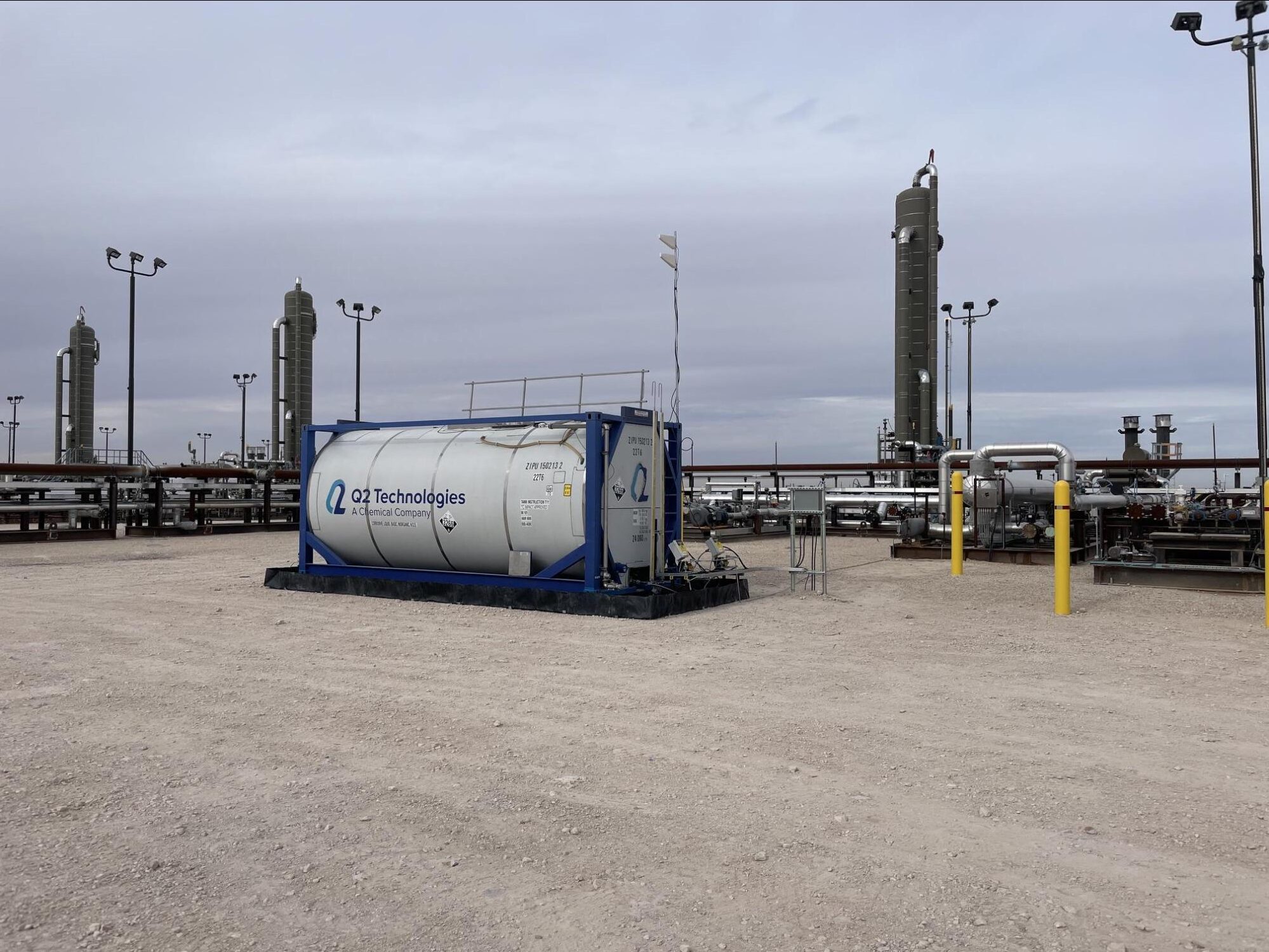
Vapor recovery unit installed at a crude oil tank battery

Vapor Recovery Units and Tank Battery H2S Control: Managing Flash Gas Emissions at Storage Sites

Vapor recovery units capture flash, working, and breathing losses from tank batteries for sale or fuel use, but they concentrate rather than remove H2S, so treating crude with scavenger chemistry upstream of the tank is generally the most effective way to control H2S in recovered vapor.

Where Flash Gas at a Tank Battery Actually Comes From

When crude oil or condensate moves from a pressurized separator into an atmospheric storage tank, dissolved light hydrocarbons come out of solution as the pressure drops, a process called flashing that typically accounts for 70 to 90 percent of total tank vapor emissions, with working losses from liquid level changes and breathing losses from daily temperature cycling making up the rest. Any H2S dissolved in the crude flashes out along with the hydrocarbon vapor, which means a tank battery’s vapor space can carry a meaningfully higher H2S concentration than the liquid crude itself.

Why Flash Gas H2S Is a Direct Worker Exposure Hazard

Tank hatches, thief hatches, and gauging points are exactly where personnel interact directly with a tank’s vapor space, which makes concentrated H2S in flash gas one of the most acute exposure risks at a tank battery, since a worker opening a hatch on an untreated or under-treated tank can encounter a spike in H2S concentration well above what continuous area monitoring at ground level would suggest. This is part of why tank battery H2S incidents remain a leading cause of oil field fatalities even at facilities with otherwise solid safety programs.

How a VRU Changes the Vapor Management Equation

A vapor recovery unit captures the flash, working, and breathing vapors that would otherwise vent to atmosphere or feed a flare, compressing them for sale into a gas gathering system or use as on-site fuel gas, typically capturing on the order of 95 percent of available vapor. But a VRU does not remove H2S from that vapor stream, it simply relocates and concentrates it, so a facility installing a VRU for methane and NGL capture still needs a plan for the H2S that comes along with it.

Sour Flash Gas and Downstream Compression or Sales Limits

Recovered flash gas carrying meaningful H2S can create corrosion risk in VRU compressors and downstream piping, and it can also fail the H2S specification required to inject the gas into a sales line or gathering system, turning a vapor recovery project’s economics upside down if the captured gas cannot actually be sold without additional treatment. Evaluating a tank battery’s expected flash gas H2S concentration before sizing and specifying a VRU avoids discovering this problem only after the equipment is already installed.

Treating Crude Upstream Reduces the H2S Problem at the Tank

Because flash gas H2S originates from H2S already dissolved in the crude entering the tank, treating that crude with scavenger chemistry upstream, at the separator or wellhead, reduces H2S in the flash gas at the same time it addresses the liquid-phase H2S specification, rather than requiring a separate vapor-phase treatment step at the VRU itself. This upstream approach is often more cost-effective than trying to scrub H2S out of the concentrated vapor stream after a VRU has already collected it.

Vapor Recovery Towers as an Additional Control Layer

Some tank batteries pair a VRU with a vapor recovery tower, a lower-pressure vessel positioned ahead of the storage tanks that captures a larger share of flash gas before it ever reaches the tank vapor space, reducing both the volume and, indirectly, the H2S load the tank and VRU have to handle. Combining upstream chemical treatment, a vapor recovery tower, and a properly sized VRU gives a tank battery multiple layers of control over both emissions and worker exposure, rather than relying on any single piece of equipment to solve the entire problem.

Q2 Technologies has helped operators reduce H2S at the source for more than 20 years, which is exactly the upstream treatment approach that keeps flash gas at the tank battery, and the vapor recovery equipment handling it, from inheriting an H2S problem in the first place. Our Pro3 and ProM chemistries are engineered for liquid hydrocarbon service, treating crude before it ever reaches the separator or storage tank. Visit

q2technologies.com to explore our full product line, read more case studies and blog posts at q2technologies.com/blogs, or check our FAQ page at q2technologies.com/faqs for common questions about H2S and mercaptan treatment.

Where Flash Gas at a Tank Battery Actually Comes From

When crude oil or condensate moves from a pressurized separator into an atmospheric storage tank, dissolved light hydrocarbons come out of solution as the pressure drops, a process called flashing that typically accounts for 70 to 90 percent of total tank vapor emissions, with working losses from liquid level changes and breathing losses from daily temperature cycling making up the rest. Any H2S dissolved in the crude flashes out along with the hydrocarbon vapor, which means a tank battery’s vapor space can carry a meaningfully higher H2S concentration than the liquid crude itself.

Why Flash Gas H2S Is a Direct Worker Exposure Hazard

Tank hatches, thief hatches, and gauging points are exactly where personnel interact directly with a tank’s vapor space, which makes concentrated H2S in flash gas one of the most acute exposure risks at a tank battery, since a worker opening a hatch on an untreated or under-treated tank can encounter a spike in H2S concentration well above what continuous area monitoring at ground level would suggest. This is part of why tank battery H2S incidents remain a leading cause of oil field fatalities even at facilities with otherwise solid safety programs.

How a VRU Changes the Vapor Management Equation

A vapor recovery unit captures the flash, working, and breathing vapors that would otherwise vent to atmosphere or feed a flare, compressing them for sale into a gas gathering system or use as on-site fuel gas, typically capturing on the order of 95 percent of available vapor. But a VRU does not remove H2S from that vapor stream, it simply relocates and concentrates it, so a facility installing a VRU for methane and NGL capture still needs a plan for the H2S that comes along with it.

Sour Flash Gas and Downstream Compression or Sales Limits

Recovered flash gas carrying meaningful H2S can create corrosion risk in VRU compressors and downstream piping, and it can also fail the H2S specification required to inject the gas into a sales line or gathering system, turning a vapor recovery project’s economics upside down if the captured gas cannot actually be sold without additional treatment. Evaluating a tank battery’s expected flash gas H2S concentration before sizing and specifying a VRU avoids discovering this problem only after the equipment is already installed.

Treating Crude Upstream Reduces the H2S Problem at the Tank

Because flash gas H2S originates from H2S already dissolved in the crude entering the tank, treating that crude with scavenger chemistry upstream, at the separator or wellhead, reduces H2S in the flash gas at the same time it addresses the liquid-phase H2S specification, rather than requiring a separate vapor-phase treatment step at the VRU itself. This upstream approach is often more cost-effective than trying to scrub H2S out of the concentrated vapor stream after a VRU has already collected it.

Vapor Recovery Towers as an Additional Control Layer

Some tank batteries pair a VRU with a vapor recovery tower, a lower-pressure vessel positioned ahead of the storage tanks that captures a larger share of flash gas before it ever reaches the tank vapor space, reducing both the volume and, indirectly, the H2S load the tank and VRU have to handle. Combining upstream chemical treatment, a vapor recovery tower, and a properly sized VRU gives a tank battery multiple layers of control over both emissions and worker exposure, rather than relying on any single piece of equipment to solve the entire problem.

Q2 Technologies has helped operators reduce H2S at the source for more than 20 years, which is exactly the upstream treatment approach that keeps flash gas at the tank battery, and the vapor recovery equipment handling it, from inheriting an H2S problem in the first place. Our Pro3 and ProM chemistries are engineered for liquid hydrocarbon service, treating crude before it ever reaches the separator or storage tank. Visit

q2technologies.com to explore our full product line, read more case studies and blog posts at q2technologies.com/blogs, or check our FAQ page at q2technologies.com/faqs for common questions about H2S and mercaptan treatment.

When introduced into a stream afflicted with H2S, the hemiformal decomposes to release formaldehyde, which then reacts with hydrogen sulfide to form stable, non-volatile byproducts such as thiomethylene glycol.  The reaction is typically fast and efficient, particularly in aqueous or mixed-phase environments. Unlike some traditional scavengers, hemiformal can maintain activity across a broad pH range and is less likely to generate problematic solids. When considering if hemiformal is the right product, certain operating conditions are reviewed, such as pH and temperature.

Heading 1

When introduced into a stream afflicted with H2S, the hemiformal decomposes to release formaldehyde, which then reacts with hydrogen sulfide to form stable, non-volatile byproducts such as thiomethylene glycol.  The reaction is typically fast and efficient, particularly in aqueous or mixed-phase environments. Unlike some traditional scavengers, hemiformal can maintain activity across a broad pH range and is less likely to generate problematic solids. When considering if hemiformal is the right product, certain operating conditions are reviewed, such as pH and temperature.

Heading 2

When introduced into a stream afflicted with H2S, the hemiformal decomposes to release formaldehyde, which then reacts with hydrogen sulfide to form stable, non-volatile byproducts such as thiomethylene glycol.  The reaction is typically fast and efficient, particularly in aqueous or mixed-phase environments. Unlike some traditional scavengers, hemiformal can maintain activity across a broad pH range and is less likely to generate problematic solids. When considering if hemiformal is the right product, certain operating conditions are reviewed, such as pH and temperature.

Heading 3

Heading 4

When introduced into a stream afflicted with H2S, the hemiformal decomposes to release formaldehyde, which then reacts with hydrogen sulfide to form stable, non-volatile byproducts such as thiomethylene glycol.  The reaction is typically fast and efficient, particularly in aqueous or mixed-phase environments. Unlike some traditional scavengers, hemiformal can maintain activity across a broad pH range and is less likely to generate problematic solids. When considering if hemiformal is the right product, certain operating conditions are reviewed, such as pH and temperature. 

Key Benefits:

  • Controlled formaldehyde release 
  • Lower vapor pressure and improved safety profile 
  • Broad applicability across liquid and gas-phase systems 
  • Reduced scaling in sour water stripping and other high-temp operations 
  • Hemiformal can make the scavenger safe for transport as it is a very stable compound 

Heading 5

Hemiformal is used in a variety of upstream and midstream applications, including: 

  • Gas sweetening systems 
  • Produced water treatment 
  • Crude oil storage and transport 
  • Sour water stripper overheads 
  • Temporary H2S mitigation during maintenance or turnaround

Its adaptability makes it especially useful in operations where system conditions fluctuate or where traditional triazine-based products may underperform. 

Heading 6

While hemiformal offers many advantages, it is not a one-size-fits-all solution. The rate of formaldehyde release can vary depending on formulation and environmental conditions. Additionally, while safer than raw formaldehyde, hemiformal must still be handled with care and appropriate PPE. 

For optimal results, formulation expertise and application-specific customization are key—something we at Q2 Technologies excel at delivering. 

Related Blogs

Why Your VRU Doesn't Solve Your Tank Battery's H2S Problem

Flash gas at a tank battery, generated as dissolved light hydrocarbons come out of solution when crude moves from a pressurized separator to an atmospheric tank, typically accounts for 70 to 90 percent of total tank vapor emissions and carries any H2S dissolved in the crude along with it. Tank hatches and gauging points put personnel in direct contact with this concentrated vapor space, making flash gas H2S one of the more acute exposure risks at a tank battery. A vapor recovery unit captures this vapor for sale or on-site fuel use, but it relocates and concentrates H2S rather than removing it, which can create compressor corrosion risk or fail a sales gas H2S specification if not planned for. Treating crude with scavenger chemistry upstream, before it reaches the tank, addresses H2S in both the liquid and the flash gas at the same time, which is generally more cost-effective than trying to treat the concentrated vapor after a VRU has already collected it.

FAQs

  1. Does a vapor recovery unit remove H2S from tank battery vapor?

    No. A VRU captures and compresses flash, working, and breathing vapors for sale or fuel use, but it does not remove H2S, it simply relocates and concentrates whatever H2S was already dissolved in the crude.

  2. Why is flash gas H2S a significant worker exposure risk?

    Tank hatches and gauging points put personnel in direct contact with a tank’s vapor space, where H2S concentration can spike well above what ground-level area monitoring would suggest, making flash gas one of the more acute H2S exposure risks at a tank battery.

  3. Can H2S in recovered flash gas cause problems for a VRU itself?

    Yes. H2S carried into a VRU can create corrosion risk in compressors and downstream piping, and it can cause the recovered gas to fail the H2S specification required for sale into a gathering system.

  4. Where is the best place to treat H2S that ends up in tank battery flash gas?

    Treating crude with scavenger chemistry upstream, at the separator or wellhead, reduces H2S in both the liquid crude and the flash gas it generates, which is generally more cost-effective than treating the concentrated vapor after a VRU has already captured it.

  5. What is a vapor recovery tower and how does it relate to H2S control?

    A vapor recovery tower is a lower-pressure vessel positioned ahead of storage tanks that captures a larger share of flash gas before it reaches the tank vapor space, reducing both the volume and the H2S load that the tank and any downstream VRU have to handle.

Related Articles