
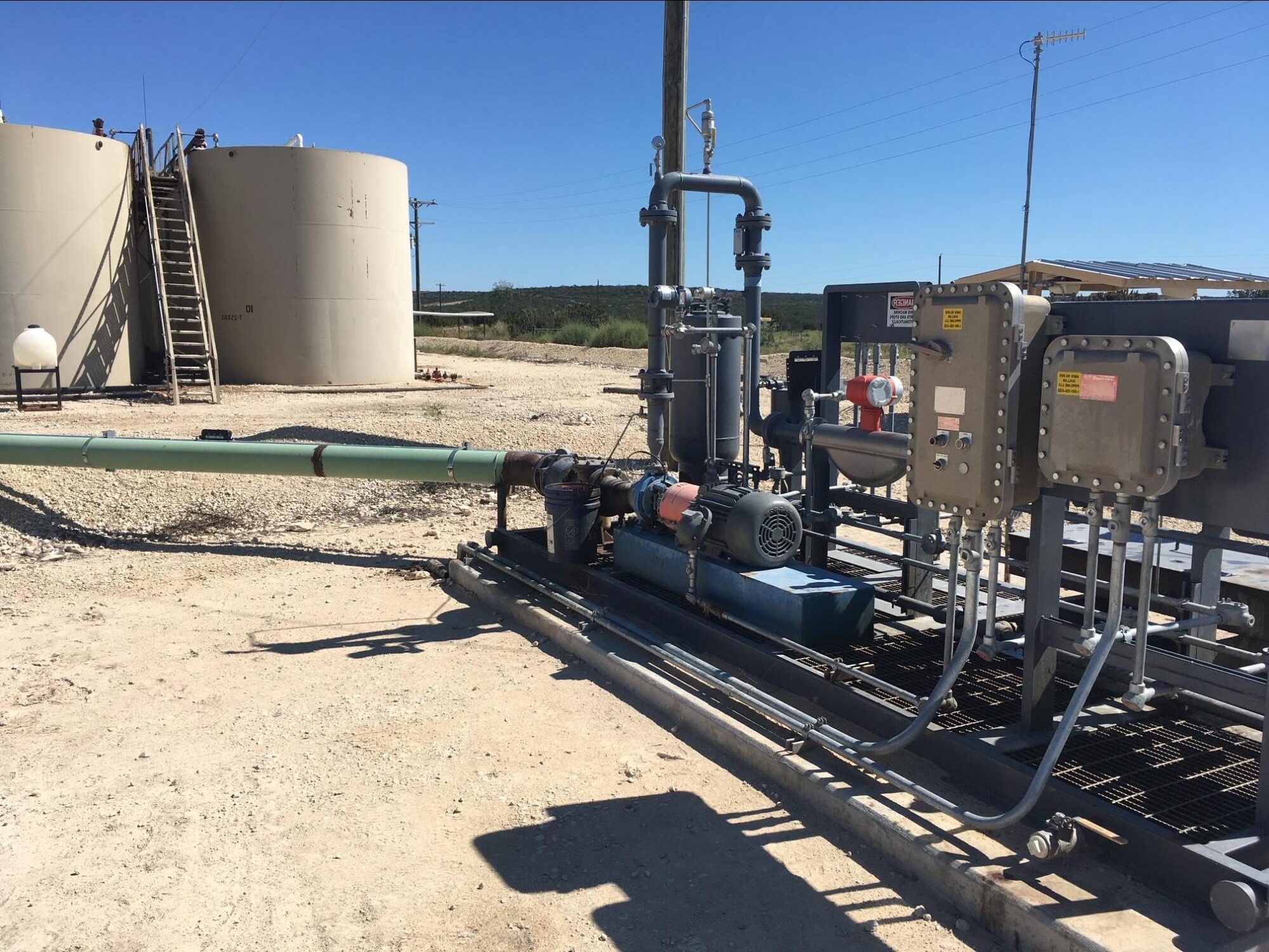
Waterflood injection facility associated with reservoir souring and nitrate treatment

Sulfate-Reducing Bacteria and Reservoir Souring: How Biogenic H2S Forms in Waterflood Operations and How Nitrate/Biocide Programs Control It

Reservoir souring occurs when sulfate in injection water, often seawater, fuels sulfate-reducing bacteria that generate H2S; nitrate treatment controls it primarily by feeding a competing group of bacteria that outcompetes SRB for the same organic electron donors, often alongside biocide programs.

What Reservoir Souring Actually Is

Reservoir souring is the appearance of H2S in produced fluid from a reservoir that was originally sweet, and it is one of the most common consequences of waterflooding, a secondary recovery technique where water, often seawater, is injected to maintain reservoir pressure and push additional oil toward producing wells.

Why Injection Water Introduces the Problem

Seawater carries a naturally high sulfate concentration, and injecting it into a reservoir along with the organic compounds already present in the formation creates ideal conditions for sulfate-reducing bacteria, which generate energy by reducing sulfate to sulfide using those organics as an electron donor. Because this is a biological process rather than a chemical reaction with the rock itself, souring severity depends heavily on injection water chemistry and reservoir temperature, not just on the oil and gas composition originally in place.

How Nitrate Treatment Interrupts the Souring Process

Injecting nitrate alongside or ahead of the water supply gives a competing group of bacteria, nitrate-reducing bacteria, an energy source that outcompetes sulfate-reducing bacteria for the same organic electron donors, which is the primary mechanism behind nitrate’s effectiveness as a souring control strategy. Nitrate treatment also works through two supporting mechanisms: some sulfate-reducing bacteria can be induced to shift their own metabolism toward nitrate reduction instead of sulfate reduction, and nitrite, a byproduct of nitrate reduction, directly inhibits the enzyme sulfate-reducing bacteria depend on to produce sulfide.

Nitrate-Reducing, Sulfide-Oxidizing Bacteria as a Second Line of Defense

A separate group of bacteria, nitrate-reducing sulfide-oxidizing bacteria, can use nitrate to oxidize sulfide that has already formed back into elemental sulfur or sulfate, providing a cleanup mechanism for H2S already present in the system rather than only preventing new formation. This means a well-designed nitrate program can both slow future souring and reduce H2S already circulating in the water system.

Where Biocide Treatment Fits Alongside Nitrate

Biocides such as THPS, glutaraldehyde, and bronopol control sulfate-reducing bacteria more directly, by killing the bacteria themselves rather than out-competing them for resources, and they remain a standard tool, particularly where nitrate alone has not achieved the needed reduction in H2S or where rapid intervention is needed. Field comparisons have found nitrate treatment can achieve substantially lower in-situ H2S levels than biocide treatment alone in some reservoirs, which is part of why many souring control programs now combine both approaches rather than relying on biocide treatment as the sole control strategy.

Monitoring a Souring Program to Know What’s Actually Working

Because souring is a biological process that develops gradually and can vary significantly across a waterflood’s injection and production pattern, tracking H2S trends at individual producing wells, alongside periodic microbial population testing, gives an operator a much clearer picture of whether a nitrate or biocide program is actually controlling souring than relying on total field H2S numbers alone. A program that looks effective at the field level can still be missing localized souring at specific wells that are on a different part of the injection pattern, which is why well-by-well monitoring remains an important complement to any broader treatment strategy.

While reservoir souring control runs through nitrate and biocide programs at the injection and reservoir level, the H2S that eventually reaches the surface still has to be managed in produced fluid, gas, and water streams, which is where Q2 Technologies’ more than 20 years of scavenger chemistry experience comes in. From Pro3 for crude and liquid hydrocarbons to Enviro-Scrub for water and biological systems, Q2 Technologies offers treatment options for the H2S that a souring reservoir sends to the surface. Visit q2technologies.com to learn more, browse our blog at q2technologies.com/blogs for related topics, or check our FAQ page at https://q2technologies.com/faq/ for common questions about H2S treatment across the production stream.

What Reservoir Souring Actually Is

Reservoir souring is the appearance of H2S in produced fluid from a reservoir that was originally sweet, and it is one of the most common consequences of waterflooding, a secondary recovery technique where water, often seawater, is injected to maintain reservoir pressure and push additional oil toward producing wells.

Why Injection Water Introduces the Problem

Seawater carries a naturally high sulfate concentration, and injecting it into a reservoir along with the organic compounds already present in the formation creates ideal conditions for sulfate-reducing bacteria, which generate energy by reducing sulfate to sulfide using those organics as an electron donor. Because this is a biological process rather than a chemical reaction with the rock itself, souring severity depends heavily on injection water chemistry and reservoir temperature, not just on the oil and gas composition originally in place.

How Nitrate Treatment Interrupts the Souring Process

Injecting nitrate alongside or ahead of the water supply gives a competing group of bacteria, nitrate-reducing bacteria, an energy source that outcompetes sulfate-reducing bacteria for the same organic electron donors, which is the primary mechanism behind nitrate’s effectiveness as a souring control strategy. Nitrate treatment also works through two supporting mechanisms: some sulfate-reducing bacteria can be induced to shift their own metabolism toward nitrate reduction instead of sulfate reduction, and nitrite, a byproduct of nitrate reduction, directly inhibits the enzyme sulfate-reducing bacteria depend on to produce sulfide.

Nitrate-Reducing, Sulfide-Oxidizing Bacteria as a Second Line of Defense

A separate group of bacteria, nitrate-reducing sulfide-oxidizing bacteria, can use nitrate to oxidize sulfide that has already formed back into elemental sulfur or sulfate, providing a cleanup mechanism for H2S already present in the system rather than only preventing new formation. This means a well-designed nitrate program can both slow future souring and reduce H2S already circulating in the water system.

Where Biocide Treatment Fits Alongside Nitrate

Biocides such as THPS, glutaraldehyde, and bronopol control sulfate-reducing bacteria more directly, by killing the bacteria themselves rather than out-competing them for resources, and they remain a standard tool, particularly where nitrate alone has not achieved the needed reduction in H2S or where rapid intervention is needed. Field comparisons have found nitrate treatment can achieve substantially lower in-situ H2S levels than biocide treatment alone in some reservoirs, which is part of why many souring control programs now combine both approaches rather than relying on biocide treatment as the sole control strategy.

Monitoring a Souring Program to Know What’s Actually Working

Because souring is a biological process that develops gradually and can vary significantly across a waterflood’s injection and production pattern, tracking H2S trends at individual producing wells, alongside periodic microbial population testing, gives an operator a much clearer picture of whether a nitrate or biocide program is actually controlling souring than relying on total field H2S numbers alone. A program that looks effective at the field level can still be missing localized souring at specific wells that are on a different part of the injection pattern, which is why well-by-well monitoring remains an important complement to any broader treatment strategy.

While reservoir souring control runs through nitrate and biocide programs at the injection and reservoir level, the H2S that eventually reaches the surface still has to be managed in produced fluid, gas, and water streams, which is where Q2 Technologies’ more than 20 years of scavenger chemistry experience comes in. From Pro3 for crude and liquid hydrocarbons to Enviro-Scrub for water and biological systems, Q2 Technologies offers treatment options for the H2S that a souring reservoir sends to the surface. Visit q2technologies.com to learn more, browse our blog at q2technologies.com/blogs for related topics, or check our FAQ page at https://q2technologies.com/faq/ for common questions about H2S treatment across the production stream.

When introduced into a stream afflicted with H2S, the hemiformal decomposes to release formaldehyde, which then reacts with hydrogen sulfide to form stable, non-volatile byproducts such as thiomethylene glycol.  The reaction is typically fast and efficient, particularly in aqueous or mixed-phase environments. Unlike some traditional scavengers, hemiformal can maintain activity across a broad pH range and is less likely to generate problematic solids. When considering if hemiformal is the right product, certain operating conditions are reviewed, such as pH and temperature.

Heading 1

When introduced into a stream afflicted with H2S, the hemiformal decomposes to release formaldehyde, which then reacts with hydrogen sulfide to form stable, non-volatile byproducts such as thiomethylene glycol.  The reaction is typically fast and efficient, particularly in aqueous or mixed-phase environments. Unlike some traditional scavengers, hemiformal can maintain activity across a broad pH range and is less likely to generate problematic solids. When considering if hemiformal is the right product, certain operating conditions are reviewed, such as pH and temperature.

Heading 2

When introduced into a stream afflicted with H2S, the hemiformal decomposes to release formaldehyde, which then reacts with hydrogen sulfide to form stable, non-volatile byproducts such as thiomethylene glycol.  The reaction is typically fast and efficient, particularly in aqueous or mixed-phase environments. Unlike some traditional scavengers, hemiformal can maintain activity across a broad pH range and is less likely to generate problematic solids. When considering if hemiformal is the right product, certain operating conditions are reviewed, such as pH and temperature.

Heading 3

Heading 4

When introduced into a stream afflicted with H2S, the hemiformal decomposes to release formaldehyde, which then reacts with hydrogen sulfide to form stable, non-volatile byproducts such as thiomethylene glycol.  The reaction is typically fast and efficient, particularly in aqueous or mixed-phase environments. Unlike some traditional scavengers, hemiformal can maintain activity across a broad pH range and is less likely to generate problematic solids. When considering if hemiformal is the right product, certain operating conditions are reviewed, such as pH and temperature. 

Key Benefits:

  • Controlled formaldehyde release 
  • Lower vapor pressure and improved safety profile 
  • Broad applicability across liquid and gas-phase systems 
  • Reduced scaling in sour water stripping and other high-temp operations 
  • Hemiformal can make the scavenger safe for transport as it is a very stable compound 

Heading 5

Hemiformal is used in a variety of upstream and midstream applications, including: 

  • Gas sweetening systems 
  • Produced water treatment 
  • Crude oil storage and transport 
  • Sour water stripper overheads 
  • Temporary H2S mitigation during maintenance or turnaround

Its adaptability makes it especially useful in operations where system conditions fluctuate or where traditional triazine-based products may underperform. 

Heading 6

While hemiformal offers many advantages, it is not a one-size-fits-all solution. The rate of formaldehyde release can vary depending on formulation and environmental conditions. Additionally, while safer than raw formaldehyde, hemiformal must still be handled with care and appropriate PPE. 

For optimal results, formulation expertise and application-specific customization are key—something we at Q2 Technologies excel at delivering. 

Related Blogs

How Sulfate-Reducing Bacteria Turn a Sweet Reservoir Sour

Reservoir souring is the appearance of H2S in produced fluid from a reservoir that started out sweet, and it is a common consequence of waterflooding, where injected water, often seawater carrying high sulfate levels, creates ideal conditions for sulfate-reducing bacteria to generate H2S from organic compounds in the reservoir. Nitrate treatment controls souring primarily by feeding a competing group of bacteria, nitrate-reducing bacteria, that outcompetes sulfate-reducing bacteria for the same organic electron donors, supported by a metabolic shift in some SRB and by nitrite's direct inhibition of the sulfate-reduction pathway. A separate group of bacteria can use nitrate to oxidize sulfide that has already formed back into elemental sulfur or sulfate, giving nitrate programs a cleanup role in addition to prevention. Biocides like THPS and glutaraldehyde remain a standard complementary tool, and many operators now combine nitrate and biocide treatment rather than relying on either strategy alone, tracking well-by-well H2S trends to confirm the program is actually working.

FAQs

  1. What causes reservoir souring in waterflood operations?

    Reservoir souring happens when sulfate in injection water, often seawater with naturally high sulfate content, fuels sulfate-reducing bacteria that generate H2S by reducing sulfate using organic compounds in the reservoir as an electron donor.

  2. How does nitrate treatment control reservoir souring?

    Nitrate primarily works by stimulating nitrate-reducing bacteria that outcompete sulfate-reducing bacteria for the same organic electron donors, supported by a metabolic shift in some SRB toward nitrate reduction and by nitrite’s direct inhibition of the sulfate-reduction enzyme.

  3. Can nitrate treatment remove H2S that has already formed, or does it only prevent new souring?

    Both. A separate group of bacteria, nitrate-reducing sulfide-oxidizing bacteria, can use nitrate to oxidize existing sulfide back into elemental sulfur or sulfate, giving nitrate programs a role in reducing H2S already present in addition to preventing further souring.

  4. Do biocides still have a role in reservoir souring control alongside nitrate?

    Yes. Biocides such as THPS and glutaraldehyde control sulfate-reducing bacteria directly by killing them, and many operators combine nitrate and biocide treatment since field comparisons have found nitrate alone can outperform biocide-only programs in some reservoirs, but not universally.

  5. How can an operator tell if a souring control program is actually working?

    Tracking H2S trends at individual producing wells, alongside periodic microbial population testing, gives a clearer picture than field-level H2S averages alone, since a program can look effective overall while still missing localized souring at specific wells.

Related Articles